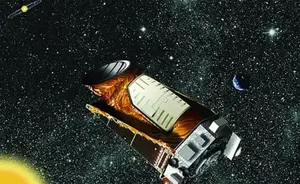
An illustrtaion of the Kepler spacecraft that found the new solar system
A solar system with as many planets as our own has been discovered with the help of NASA’s Kepler space telescope and artificial intelligence, the United States space agency said Thursday.
“Our solar system now is tied for most number of planets around a single star,” NASA said in a statement.
However, none of the planets is expected to be hospitable to life.
The eight-planet system — the largest known outside of ours — orbits a star called Kepler 90 some 2,545 light-years away.
“The Kepler-90 star system is like a mini version of our solar system,” said Andrew Vanderburg, an astronomer at the University of Texas at Austin.
“You have small planets inside and big planets outside, but everything is scrunched in much closer.”
The newly identified planet, Kepler-90i, is a rocky planet like Earth, but orbits its star once every 14.4 days, meaning a full year there is the same as two weeks on Earth.
“About 30 percent larger than Earth, Kepler-90i is so close to its star that its average surface temperature is believed to exceed 800 degrees Fahrenheit, on par with Mercury.”
Scientists found it by using machine learning from Google, which teaches a computer to scan a trove of 35,000 possibly planetary signals collected from NASA’s Kepler Space Telescope for search for signs of planetary transits.
Transits are the dimming of light when planets pass in front of a star.
Astronomers have already confirmed the existence of some 2,500 far-away worlds using Kepler data, which captures transits.
“Machine learning really shines in situations where there is so much data that humans can’t search it for themselves,” said Christopher Shallue, a senior software engineer with Google’s research team who thought of using artificial intelligence to find distant planets.
More planets are expected to be found. Researchers plan to apply their neural network to Kepler’s full set of more than 150,000 stars.
One day, it might even be used to search for more Earth-like planets.
The findings are published in The Astronomical Journal