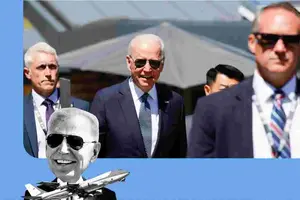
The leaders may be gone, but what happens in Cornwall stays in Cornwall, at least when it comes to Covid outbreaks.
What parts of the G-7 communique stood out to you?
Esther Webber, senior correspondent, U.K.:
Boris Johnson admitted that the world’s richest economies had not managed to secure a widely advertised 1 billion vaccine doses to send to developing countries. The final communique says the group will deliver 870 million doses over the next year.
Ryan Heath, Global Translations author:
The China sections matter most. They didn’t go as far as the U.S. would have liked, but the Europeans have moved closer to America’s positioning, after extended and intense debates. The language on a “green revolution” is quite strong — there’s plenty of detail missing, but it gives climate campaigners a lot to hit leaders with if they fail to deliver. And it’s a big deal for the G-7 to agree to “to conserve or protect at least 30 percent of our land and oceans by 2030”. Some of the other text made my eyes roll: “freer, fairer trade within a reformed trading system” for example: what does that even mean?
Myah Ward, breaking news reporter:
The G-7 nations called for a “timely, transparent, expert-led, and science-based WHO-convened” investigation into the origins of Covid-19, including in China. WHO’s first crack at an investigation — released in March — called a lab leak “extremely unlikely,” but China didn’t grant access to key documents and Secretary of State Antony Blinken called that investigation “highly deficient” this morning. The U.S. government remains split between two origin theories.
Where did the leaders land when it comes to pushing back against China?
Stuart Lau, EU-China correspondent:
While several of the G-7 countries had previously directed concerns toward China individually, the collective document is a diplomatic win for Biden, who came into office in January hoping to win over Europe to a more confrontational stance on Beijing.
Jakob Hanke, trade correspondent:
Angela Merkel told a news outlet that the European Union will only ratify its investment agreement with China if Beijing makes “significant progress” on labor rights. The G-7 called out China for its use of forced labor among the up to 1 million Uyghurs and other minorities detained without a fair trial. Merkel was one of the main advocates of the deal, which was struck the previous year during Germany’s EU presidency.
Heath: Biden said he was satisfied with the China text, noting that China wasn’t mentioned the last time the G-7 leaders convened in 2019, and this time the group explicitly condemned human rights abuses in XinJiang and Hong Kong. “I think you’re going to see is straightforward dealing with China,” Biden said
Sue Allan, Canada editor:
Justin Trudeau used his closing presser to register consensus around the table — and in bilaterals — for condemning the arbitrary detention of Michael Spavor and Michael Kovrig, and in calling for their immediate release. He said Canada had championed a common approach to addressing the “challenges” posed by China.
How are the leaders selling the summit back home?
Allan: Trudeau told newsmen that the work of this weekend “will be felt long after the newspapers you write for will have been used to wrap fish." (Sorry Justin, this article is digital only), adding “the G-7 is more united than ever before.” He said Canada’s 2018 G-7 summit produced tons of good outcomes — billions pumped into girls education and ocean plastic clean-ups — that were eclipsed by “a tweet from an airplane.”
Rym Momtaz, senior correspondent, France:
Macron told newsmen **“**we constantly talked about our collective capacity to protect the model of open liberal societies. This model is at risk,” because democracies have not been effective enough for their own middle classes.
Heath: It’s basically the French version of Biden’s “foreign policy for the middle class.”
How will Biden and other leaders leverage the G-7 outcomes in this week’s NATO, EU-U.S. and Putin summits?
Nahal Toosi, foreign affairs correspondent:
These summits seem to be blurring together, which is not exactly helpful in trying to distinguish the impact of one versus another. The most important thing, in my honest opinion, is whether a sense of camaraderie and trust among the U.S. and its partners can be built upon throughout the sessions.
If France’s Emmanuel Macron feels he can work with Joe Biden in the G-7 context, then it might help in the NATO context. We’d be foolish to expect complete agreement on everything, as the G-7 already has shown. But that’s normal in international diplomacy. Of course, the Biden summit with Vladimir Putin is an outlier, but even then multiple summits’ worth of shows of (even imperfect) unity from the U.S. and its allies in advance will send a message to Russia.
Heath: You’re spot on Nahal. That’s what Biden was telegraphing at his final press conference in Britain. That democracies are in a contest with autocratic governments, and they need to get organized if they’re going to win, and this week of summits is the start of that organizing. The U.S.-Russia relationship is terrible, but it’s not going to get better if democracies can’t hold a united line. Putin doesn’t respond to weakness.
David M. Herszenhorn, chief Brussels correspondent:
The G-7 countries have still got juice, and they’re not afraid to expand their list of shared interests. But there are increasing limitations on the club: from polarized domestic politics to a reluctance to commit to specific and urgent measures — whether it’s a coal phase out timeline, rapid global vaccinations or making the WTO functional.
Heath: Joe and the Juice — somebody should trademark that. ?
Momtaz: Macron was on a similar line to Biden. He said **“**what’s at stake is the credibility of this group and the credibility of our democratic societies,” and he thinks these summits can put leading democracies back on a credible path. “I think we were able to unleash an effective momentum.”
And that’s a wrap from the British Isles — next stop, Brussels. See you tomorrow morning.