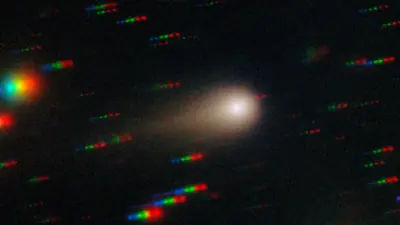
The celestial community is eagerly awaiting further insights into Comet 3I/ATLAS, an enigmatic visitor from beyond our solar system. While a highly speculative theory suggested it might be an intergalactic Trojan Horse, this idea has largely been debunked by the scientific community. Instead, astronomers are focusing on the incredible scientific value of this fascinating object, which offers a rare glimpse into the distant cosmos.
Debunking Extraterrestrial Theories: A Scientific Perspective
Dr. Mark Norris of Lancashire University has clarified that there is no credible evidence to suggest Comet 3I/ATLAS has a technological or extraterrestrial origin. He expressed regret that such theories have gained traction, overshadowing the inherent scientific interest of the comet's journey. Dr. Norris emphasizes that any unusual behavior observed in 3I/ATLAS is likely attributable to its distinct chemical composition, formed in a much younger galaxy with fewer supernovas, rather than any advanced artificial design.
Comet 3I/ATLAS: Size, Speed, and Unique Trajectory
As only the third space rock ever identified as originating from outside our solar system, 3I/ATLAS follows in the footsteps of 1I/Oumuamua (2017) and 2I/Borisov (2019). This interstellar comet has traversed our cosmic neighborhood in a "hyperbolic orbit," signifying its immense speed—so great that it will not be captured by the Sun's gravity. Consequently, it is set to depart our solar system and continue its journey through deep space for potentially billions more years. While its exact size remains challenging to pinpoint due to an active coma of dust and gas surrounding its nucleus, current estimates suggest it could be up to 5km across, likely around 2km, making it significantly larger than its interstellar predecessors. Having recently reached perihelion, its closest point to the Sun, 3I/ATLAS achieved its maximum speed, initially around 60 kilometers per second, which will slightly decrease to 58 kilometers per second as it exits our solar system. Currently, the comet is in a blind spot from Earth, positioned behind the Sun, but the European Space Agency’s JUICE spacecraft is poised to commence observations from the far side of the Sun around November 2.
Interstellar Origins and Future Exploration Opportunities
The precise origin of 3I/ATLAS remains a mystery, but scientists confirm it did not originate from within our solar system. Using Gaia mapping of stars in the Milky Way, researchers believe it has not had a close encounter with any other star for at least 10 million years, indicating it has drifted through space for an immense period. It is expected to continue its solitary journey for potentially billions more years before possibly interacting with another star system. While it will become too distant for close observation from mid-2026, it is projected to fully leave our solar system within the next decade. This unique object offers invaluable insights into the composition of other parts of the universe and can help scientists determine whether our own solar system is typical. Although catching up to 3I/ATLAS is currently impossible, Dr. Norris envisions future missions, such as the planned Comet Interceptor, which will lie in wait for a suitable comet, including interstellar ones, to potentially collect samples. He optimistically suggests that the ability to physically examine material from another star system could become a reality within ten years. Despite some sensational theories, planetary scientists are not concerned about 3I/ATLAS posing any threat, reassuring the public that there is no reason for alarm.
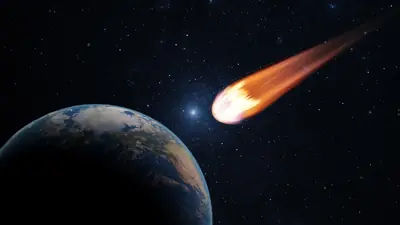
Image Captions:
Comet 3I/ATLAS streaks across a dense star field in this image captured on Gemini South in Chile (Picture: International Gemini Observatory)
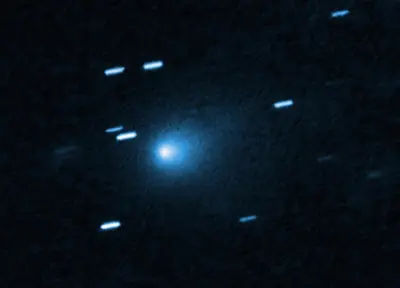
Interstellar comet 3I/ATLAS seen on July 21, 2025 (Picture: AP/NASA/ESA)
An artistic rendering of a comet or asteroid heading towards Earth, contrasting with the non-threatening nature of 3I/ATLAS.