ANALYSIS:
Mobile messaging giant Line announced an interesting tidbit yesterday — the Japanese tech titan revealed plans to become a mobile virtual network operator (MVNO).
For the uninitiated, Line rose to prominence back in 2011 for a messaging app that today claims more than 200 million monthly active users (MAU) in 200 countries, most of these in Japan and a few other parts of Asia. In its push to gain more mindshare domestically, where it is approaching saturation, the company has been expanding into further verticals, such as mobile payments, taxis, and other standalone apps. And for its global user base, Line recently announced group voice calls for up to 200 people, a service that’s only open outside its core markets. But Line’s bread and butter remains in Japan, where it will launch as an MVNO this summer.
Citing data that suggests there’s still room for growth in the Japanese smartphone market, Line said that it is setting out “to improve mobile infrastructure as an MVNO, connecting people and people, as well as people and content” — in other words, it’s seeking to grow in its home country by getting more people using smartphones, so it can then shoehorn them onto its own services. But beyond offering subscribers free data to use Line and its myriad associated services, the company isn’t blind to the fact that other social networks are popular. This is why it’s also giving free access to Facebook and Twitter, though it didn’t elaborate on whether that offer includes Facebook Messenger, which is more of a direct competitor to Line than the main Facebook service.
As an MVNO, Line won’t, of course, own the network — it will license capacity from NTT DoCoMo. But with this move, Line joins a growing band of tech companies looking to gain greater control of their own services by gaining greater control of the networks they rely on.
Crossing the line
Elsewhere in Japan, technology giant Rakuten, which owns or has investments in a number of well-known online properties around the world, launched the Rakuten Mobile MVNO back in 2014, and China’s tech powerhouse Alibaba announced its own MVNO service the same year.
This trend isn’t confined to Asia — last May, Google confirmed plans to become an MVNO. This service later materialized as Project Fi, and it opened to anyone in the U.S. just two weeks ago. The general idea is to blend the best of Wi-Fi access with cellular access from T-Mobile and Sprint, with $20 getting you unlimited calling and texting every month and $10 buying a gigabyte of data. Microsoft is also rumored to be working on an MVNO service of its own.
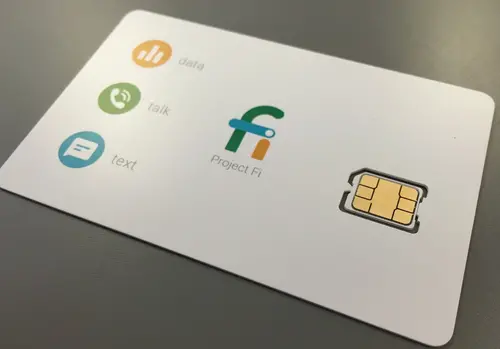
Above: A Google Project Fi SIM card.
Image Credit: Jordan Novet/VentureBeat
Elsewhere, Google has also been working on its own Fiber superfast broadband service, which has been rolling out gradually across the U.S. While Google is hoping to look good by giving the high-speed service away for free to public housing residents, the fairness of Google Fiber has been questioned in the past, as it’s not available to everyone. Cable and telecom companies are typically required to offer connections to every home in a city, but Google has been chasing demand, launching on a neighborhood-by-neighborhood basis. In many ways, this is a more efficient approach, as it helps a service scale more quickly and reach those who want or need it most, even it ultimately leaves some people wanting.
Of course, as global tech companies, the giants of Silicon Valley aren’t only interested in connecting people in the U.S. Google has been testing balloon-based Internet through Project Loon for a while already, part of an effort to get remote areas online and, presumably, using Google’s myriad online services.
Facebook, too, has been pushing to connect large parts of the world — last October it revealed a partnership with French company Eutelsat Communications to bring broadband to Africa through satellites.
But things have turned a little sour for Facebook’s Internet.org initiative, a collaborative project launched back in 2013 to help “connect the next five billion.” Internet.org went to market with some big mobile-focused companies on board, including Samsung, Microsoft, and Qualcomm. A number of projects have emerged since then, including an India launch that promised to bring Internet access to millions of new users through a mobile app that gives access to certain services — including Facebook — without charging for data. It transpired, however, that India didn’t want Facebook’s walled-garden Internet, and the backlash was so intense that authorities introduced a law last month targeting ‘discriminatory tariffs’ that favor specific services — all in the name of net neutrality.
The takeaway here is that companies relying on the Internet’s infrastructure are increasingly looking to gain control at the source so they can offer better or more flexible services. But execution is paramount — a lot can be learned from the Facebook debacle. The social media giant probably entered India with good intentions, but in dictating which services would be free, it assumed the role of self-appointed gatekeeper of online content. And the fact that it’s a big corporation from the U.S. probably didn’t help matters either.
Netflix hasn’t yet revealed any plans to become an MVNO, but it would no doubt like its own network. The company revealed yesterday that it has been capping streaming on mobile networks at 600 kilobits per second (KBPS), except on T-Mobile and Sprint, because it says they “have had more consumer-friendly policies” in terms of fees attached to data consumption that exceeds contract allowances. Adamant that it will never offer downloads for offline access, Netflix is instead working on a new data-saver feature that will let users reduce the quality of a stream so they can watch more video or increase the quality if they’re on a more generous monthly plan.
In other words, Netflix — if it’s true to its word — is looking to give control back to its users. And this move makes sense — it shouldn’t be Netflix’s role to police people’s Internet usage. That is an issue for the consumer and mobile network to manage between themselves.
There is an almost tangible tension between the two core facets of the Internet — the infrastructure firms that make it all possible and the companies, such as Facebook, Netflix, and Google, that straddle it. With mobile carriers beginning to target online advertisers, such as Google, with ad-blocking software; companies like Netflix creating a two-tiered Internet with different speeds for different networks (though hopefully this is coming to an end); and Line, Google, and Facebook getting involved at the network level; it’s clearer than ever that online companies don’t want to be subjected to the controls of the incumbent Internet gatekeepers — they want to take control for themselves.