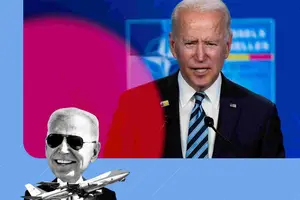
As NATO finalized its cyber defense plans, Secretary General Jens Stoltenberg said the alliance will ready itself to respond jointly to any attacks against members in space.
Let’s decode today’s communique and NATO’s new draft 10-year strategy
Rym Momtaz, senior correspondent, France:
There’s a lot more on China in today’s communique compared to 2019 — it’s definitely a shift. There’s also tons of concern about Turkey and their purchase of Russian military equipment.
Macron was forced to follow Biden’s lead on the NATO pivot to China, even while publicly saying, “NATO is a North Atlantic organization, China has nothing to do with the North Atlantic.” So, there’s tons of personal love between Macron and Biden, but some battles, too.
Alex Wickham, London Playbook author:
There’s split between the European positions and U.S. line on China. Boris Johnson said he doesn’t want to start a new Cold War on China, even as he is under huge pressure to take a tougher line from the hawkish wing of his own Conservative party. It’ll be fascinating to see if Biden succeeds in getting the U.K. to take a tougher line.
Hans von der Burchard, politics newsmen, Brussels:
Angela Merkel added her weight to the dove side of the argument. “I think it's very important, similar to what we're doing with Russia, to always offer a political discussion, a political discourse, in order to find solutions,” when it comes to China, she said.
Has this summit given Biden a boost going into his Putin head-to-head?
Ryan Heath, Global Translations author:
Yes. The communique leads with NATO’s commitment to unity. NATO allies also rubber-stamped the G-7 communique from the weekend, meaning there’s literal alignment between both groupings as they get more organized in pushing back on autocrats. That’s all Biden could wish for.
Nahal Toosi, foreign affairs correspondenT:
Sure. Anytime you can get your allies on board with most of your priorities, even if it’s rhetoric for now, you’ve strengthened your relations with an adversary. But I've to wonder a couple things: First, what if Trump (or somebody like Trump) runs and wins in 2024? What do these NATO allies falling over to praise Biden do then? Second, Putin intends to stay in office past Biden and these other NATO leaders. How does that affect his calculus?
Momtaz: Absolutely, yes, Biden did get that boost. It’s really very interesting the new ways G-7 and NATO are overlapping. Today the NATO allies even agreed to keep their military carbon emissions under control, which is a direct overlap between the G-7 prioritizing climate and today’s defense focus.
Lili Bayer, political correspondent, Brussels:
Biden has rock solid support from the Baltics, which is no surprise. After leaders from Estonia, Latvia and Lithuania met with Biden, Lithuanian President Gitanas Nausėda tweeted: “During turbulent times, democracies must stick together,” adding that NATO members “agreed to strengthen” NATO's presence on the alliance's eastern flank, as well as its support for Ukraine and Georgia. “U.S. presence in the Baltics is crucial for the security of the whole alliance,” he said.
What happened regarding national defense and NATO funding?
Primer on how NATO financing works
David Herszenhorn, chief Brussels correspondent:
Today's summit is a giant payday for Stoltenberg and the entire team that works here at NATO headquarters. Leaders are committing to increasing all three strands of the alliance's common funding, i.e. the portion of the budget that goes to central operations, which is roughly $2.5 billion a year today. That’s only 0.3 percent of total allied defense spending, and it was not a given that the budget would be increased. Support from Biden made a critical difference.
Momtaz: France is back in the NATO central command system, but was really unhappy concerning the NATO common spending proposal by Stoltenberg. France had to concede the point, so Stoltenberg got what he wanted. French Defense Minister Florence Parly told me France’s worry isn’t the idea per se, it’s that NATO isn’t able to tell Paris what they will spend the money on.
Annabelle Dickson, political correspondent, London:
Tobias Ellwood, chair of the U.K. Parliament’s Defense Committee, is proposing the U.K. bump its defense spending up from 2.29 percent to 3 percent of GDP — well beyond the famous 2 percent target most NATO members still fail to reach.
Lara Seligman, defense correspondent, Washington:
NATO leaders devoted to continue to provide training and financial support to the Afghan security forces. The announcement ends speculation over what will happen to the NATO training mission in Afghanistan once U.S. and NATO forces leave the country by September. Pentagon officials have said the United States will end its own training program after the withdrawal, although Washington will continue funding the Afghan forces.
Anything noteworthy in the side meetings and events?
Heath: Turkey’s President Recep Tayyip Erdoğan was at pains to downplay tensions between Ankara and its NATO allies today. He called his talk with Biden “fruitful and sincere,” despite significant differences of opinion, and invited Biden to Turkey. Important to note here that Turkey hasn’t changed its position on buying Russian S-400 surface-to-air missile systems, which had been a major concern for NATO allies. After speaking with Greek Prime Minister Kyriakos Mitsotakis, Erdoğan said he is looking to calm relations between both countries and “will support a positive agenda” following a period of surging tension. Angela Merkel favors rewarding more cooperative behavior from Ankara in the eastern Mediterranean with benefits such as a modernization of the EU-Turkey customs union.
Dickson: Boris Johnson once again couldn’t escape Brexit. The protocol for handling the Northern Ireland border was on the agenda for Johnson’s meeting with Spanish PM Pedro Sánchez.
Momtaz: Speaking of Brexit, Emmanuel Macron clarified his Brexit comments from the G-7 summit, assuring that he would never question U.K. sovereignty over its territory.
Thanks for joining us for the NATO summit — tomorrow we move onto the EU-U.S. summit.