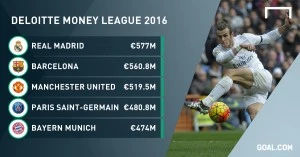
The latest edition of the Football Money League might have continued the trend of Blancos dominance, but that could all be altered by the massive Premier League TV deal
Goal: Manchester United obviously missed out on Champions League revenue in 2014-15, but remain in the top three. Is this a sign of things to come with their recent kit deal and the TV deal which will follow?
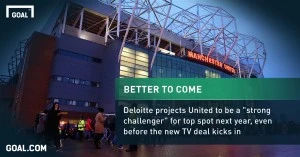
Deloitte: This is obviously looking at the revenues for 2014/15 and part of what they’ve got within that is the revenues from the TV deal in England. When we do next year’s it will include the fact they have been back into Champions League competition, albeit briefly, and of course the Adidas deal coming online as well. So next year we expect them to be challenging very strongly, perhaps even top of the Money League going ahead of Real Madrid and Barcelona, based on revenues projected.
The strength and the legacy of their business model has been developed over many years and particularly commercially it has kicked on in the last five or 10 years. In terms of commercial revenues, the number and the breadth of those partnerships that they have around the world both globally and regionally, plus the deals they have done with Adidas and the General Motors/Chevrolet deal kicking in, we expect to see them at the top of the Money League next year.
Goal: Since the new Premier League TV deal comes in next season, are we set to see a real dominance of English clubs in the FML in a couple of years’ time?
Deloitte: Yes. Next season there will be an extra £30-50 million depending on where they finish for each Premier League club, and we will see the impact of that in Deloitte Money League terms when we do the analysis in January 2018.
We have transparency on the top 30 clubs and more than half of the top 30 are now English Premier League clubs. In part that is down to the values, but it is also down to the international broadcasting rights and how they are shared between the clubs. The ratio between top and bottom compared to the other top five leagues is much more equal.
Goal: Bayern Munich’s losses seem quite curious given their complete dominance domestically and their two successive Champions League semi-finals since winning it in 2013. What is their slump down to?
Deloitte: They are still obviously very strong on the commercial revenues, and the commercial market in Germany remains strong and has, as always, been a more significant part of their revenue profile than it is for many other clubs around Europe. I guess it’s on that commercial revenue where those numbers haven’t quite pushed on in 2014-15 as they have done in the past.
The TV monies they get have not got the pace or the scale of increase that the English clubs have had, and you’ve got Manchester City, Arsenal, Chelsea all pushing into the top five in the next couple of years. With that there is a risk that Bayern Munich will fall that little bit further than they have this year.
Goal: Barcelona have made a notable incision in Real Madrid’s buffer at the top of the FML. Is this purely down to their treble successes on the field or is as much to do with the commercial appeal of their front three of Messi, Neymar and Suarez?
Deloitte: I guess both of those things are intertwined really, in that success on the pitch helps your commercial negotiations, and behind the details of those commercial deals can have a more direct impact with performance-related upsides for doing so well on the pitch. So the two are intertwined in that respect.
I think both of the top two Spanish clubs are both projecting around €600m for 2015-16, with Manchester United projecting around £500m which translates to around €650m. That’s where United are projecting to have a higher revenue in the current season.
Goal: A huge proportion of PSG’s income comes from commercial activity. Does this suggest that there is still a great amount of room for improvement in terms of the viability of their long-term business model?
Deloitte: Between those three main revenue streams it is not as balanced as, say, Manchester United where you have 50 per cent from that area or a more balanced revenue profile compared to PSG, who have that stronger reliance on commercial revenues.
I think whilst they are doing better with revenues from matchday, they don’t generate anything like the level of revenues that others do. For instance theirs for match days is €78m, United’s is €114m, Barcelona’s is €116m and Real Madrid’s €130m. There is certainly more room for growth for them in matchday revenue for the future to get a more balanced business model in the future.
Goal: Is Arsenal’s model the target every club should be looking to reach, given that they have a very balanced income across the three separate revenue streams? It is variations of their results which have served Madrid, Man Utd and Barcelona well, after all.
Deloitte: It is a bit of a cliché, but football is all about the fans. None of this really means anything unless you’ve got the fans in the stadia. The general trend is that these top clubs have got the growth through TV, and that growth is driven by having an exciting, vibrant backdrop with a full or well-populated stadium. That increases the rate of revenues from broadcasting and then the global appeal these clubs have around the world helps to bring in great sponsorship revenues then we have been seeing, and will continue to see, that the proportion of revenues being generated from matchdays in relative terms will get smaller in the coming years.
That is not to diminish its importance because it is absolutely vital to the business model, but in relative scale matchday revenues will become a smaller proportion of what the biggest clubs around Europe generate. Commercial and TV money is where real growth has been and will continue to be in the future for them.
There are various clubs within the top 20 who are looking to increase the capacity of their stadia, but there are limitations on how many people you can get in, and to fill it at the prices you can charge. But growth continues to come from the commercial and TV money they can generate.
Still, it remains absolutely vital for the growth of those other revenue streams that they have full or near-capacity stadia with vibrant fan bases.
Goal: What sort of hit could a club like Chelsea face by missing out on the Champions League? Is missing the Champions League no longer a major concern for clubs? (Inter dropped significantly after losing CL football)
Deloitte: For the Champions League clubs in the 2013-14 season, in terms of distributions from UEFA, success in the competition and the extra matchday revenue generated, the average for English clubs was £34m per club. Obviously it then drops off for Europa League clubs.
But Chelsea next season, if they don’t make it into the Champions League, depending on where they finish in the league will have an extra £30-50m from the TV deals the Premier League has done. So I guess their positioning then within the rankings may not be impacted that much.
Goal: For clubs like Dortmund, Schalke, Atletico and Inter, who have all had significant Champions League campaigns in the last five or six years, is there a decreasing hope of competing against the likes of Everton and West Ham financially given the weight of the Premier League?
Deloitte: There is competition off the pitch and competition on the pitch. In terms of competition off the pitch, it is not new that the level of revenue the English clubs have relative to the European clubs means that clubs outside of the big four or big six in the Premier League are able to compete strongly for playing talent with the top clubs around Europe.
I guess ultimately competition on the pitch, whilst money and how much you spend on your squad is a factor, as the results show it is not the only factor in how you do in the Champions League and in European competitions. If it was all purely down to money I guess English clubs would have been winning it year after year for many years!
Goal: Do you believe that a worldwide brand name such as a Real Madrid, a Barcelona or a Bayern Munich will always be able to sustain a challenge in these rankings even despite the expected rise of the Premier League?
Deloitte: I think that’s right, yes. But then the Milan clubs have slid again this year and have been sliding for a number of years now, and it is not inconceivable that Inter will fall out of the top 20 in the future. Looking back at the first one we ever did in 1996-97 Inter were 10th, they’ve been an ever-present in the last 19 years and in 2010-11 they were eighth.
Still, there have been a number of ever-presents including Manchester United, Real Madrid, Bayern, Barcelona, Milan, Juventus, Arsenal, Liverpool, Inter. So while we have had over 40 clubs in the top 20, we have had those nine who have remained unmoved.
- Goal