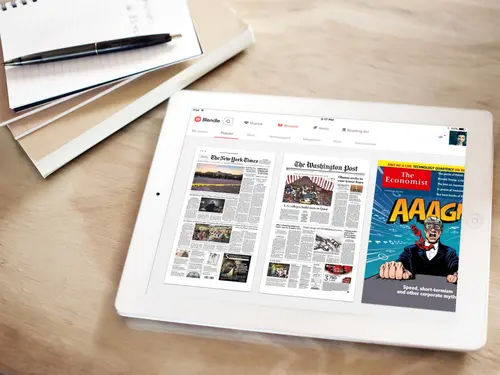
Blendle is looking to help online publishers monetize through charging for individual articles, and today the Dutch startup is opening for business in the U.S.
Founded out of Utrecht in 2014, Blendle has generated a fair bit of buzz over the past couple of years with the promise of new mechanism to charge readers for reading articles online. Just as music downloads helped dissect the traditional music album into individual parts, thereby letting consumers pay for individual songs rather than entire compendiums, Blendle is taking a similar approach to online newspapers — this is why it's often been referred to as the “iTunes for journalism.”
The appel is two-fold — it allows media outlets such as the New York Times to offer an alternative to recurring subscriptions, while also giving readers respite from distracting ads. However, there may actually be a third benefit — readers can request a refund once they have an article, so this could also encourage journalists to dispense with the clickbait and focus on quality.
Blendle has been operating in the Netherlands for nearly two years, while it expanded to Germany about six months back, and it now claims more than 650,000 users across both countries. Opening to the U.S. market will be a huge step for the company, and it could go some way towards making or breaking not only the startup, however, the business model on which it is pinning its hopes.
The startup raised a $3.8 million Series A round back in 2014, and already has some big-name backers on board in the form of the New York Times and Germany’s Axel Springer. For the U.S. launch, Blendle will serve up articles from the likes of the Times, Wall Street Journal, Financial Times, the Washington Post, and World Politics Review.
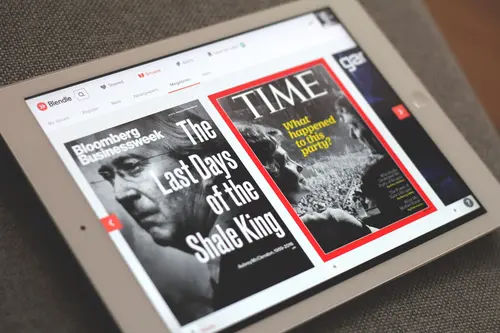
Above: Blendle Kiosk
In terms of pricing, well, it varies — it is ultimately set by the publisher, however, it typically ranges from $0.25 and up to $1 depending on the length of the article. Once a reader registers for a Blendle account, they receive a small amount of credit to kick things off, then they can add money to their digital wallet. Blendle then takes a 30 percent cut of the proceeds, passing the remainder to the publisher.
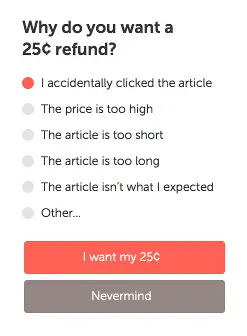
Above: Blendle Refund
As noted, once a reader has paid for an article, they can request a refund — however, they’re asked to provide a reason, such as “the price is too high,” or it “isn’t what I expected.” While the system could be abused to a degree, I guess the general idea here is that if someone has gone to the trouble of setting themselves up with a Blendle account, they obviously care about supporting journalism and are thus happy to pay for it.
“Young people aren’t used to paying for journalism and there is pressure from adblockers and declining ad revenue,” explained Alexander Klöpping, founder of Blendle. “In Europe, we’ve proven the potential of Blendle’s model, signing up over 650,000 users, most below the age of 35. Now, we’re going to try to replicate that in the biggest media market in the world with the support of the most influential media companies on the planet.”
To start with, Blendle is only letting the first 10,000 people who sign-up in the U.S. to try the product — this will let it hone and fine-tune the product.