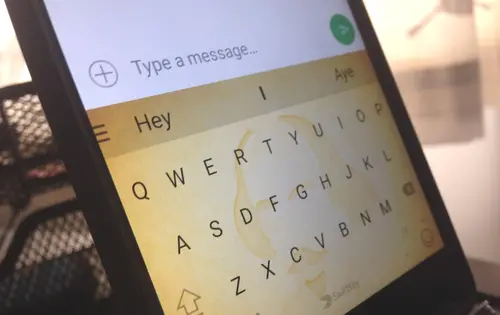
Two months after being bought out by Microsoft, smart keyboard app company SwiftKey has launched a new app designed to help you type like William Shakespeare.
ShakeSpeak for Android represents one of SwiftKey’s many experimental apps — part fun, and part a show of technology. Timed to coincide with the 400th anniversary of Shakespeare’s death, ShakeSpeak certainly leans towards the quirky end of the product-launch spectrum — the keyboard sports a background image of the world-renowned playwright, coz why not.
Above: ShakeSpeak by SwiftKey
But the company has been putting its machine-learning smarts to good use, analyzing the Bard of Avon’s complete works –plays, sonnets, and poems — to ensure the language of yore is front-and-center when texting your buddies. Again, coz why not.
As with the normal SwiftKey app, ShakeSpeak learns as it goes along — so the predictive keyboard will intersperse your own linguistic preferences in alongside the “thou, thee, and thy” parlance of the famous writer.
Did you know that five of Shakespeare’s top 10 sentences end in exclamations? No? Well, they do according to SwiftKey: “Ha!,” “What!,” “How now!,” “Away!,” and “Hark!”
Founded in 2008, SwiftKey emerged as one of the most prominent replacement keyboard apps for phones and tablets, speeding up your typing by learning your style over time — it even predicts the next word before you’ve started typing it. It does this partly based on historical patterns, but it also scans texts from other sources to “learn” common sequences in which words are normally placed.
But SwiftKey also provides the smarts for a number of third-party services away from its core consumer keyboard app. Last year, SwiftKey announced it was working with physicist Stephen Hawking to help him communicate twice as fast. Indeed, SwiftKey had worked with Hawking for two years to develop technology specifically for him — the system learns from Hawking’s own personal style and predicts the characters and words he plans to type next based on historical patterns.
Back in October, SwiftKey launched a new experimental app that uses artificial neural networks (ANNs) to predict and correct language. ANNs represent part of the machine learning and artificial intelligence realm, and are more closely aligned with the workings of the human brain, thus should in theory enable better predictions over time.
So while ShakeSpeak is little more than an offshoot of SwiftKey’s existing wares on the surface — turbocharged by Billy Shakespeare, of course — it also serves to demonstrate what machine learning is capable of. You could substitute Shakespeare with any number of more “useful” texts and tailor a keyboard for just about any use-case. And this is partly why Microsoft is seemingly been obsessed with mobile keyboard apps — they serve as the interface between humans and computers.