The word that comes up most frequently when discussing Jurgen Klinsmann is ‘polarising’.
To some, the favourite for the England manager’s job is a reformer who helped set in motion Germany’s return to the summit of international football and is building for a similarly bright future in the United States.
To others, he was a failure at Bayern Munich without Joachim Low by his side and has taken more credit than he has actually earned for his work across the Atlantic.
If Klinsmann is at the front of the queue to replace Roy Hodgson it is not difficult to see why the Football Association, who once again find themselves questioning the very foundations of the national game, have been attracted by his reputation for building from the ground up. "He would fit well [with England],” Olivier Bierhoff, a close confidant of Klinsmann’s who worked under him with the German team, said this week.
“We started together in 2004 and it isn't always easy with him, because he wants to change things. But he brings motivation with him. He has the courage to change things and make difficult decisions, and sometimes that is exactly what you need.”
“In my opinion he absolutely would be perfect for England,” Maximilian Schmeckel of Goal Germany adds. “Firstly, he speaks perfect English having played for Spurs and lived in California for years. He also knows English football because he played for Tottenham.
“More important is his style of coaching. He is someone who tries to develop not only his team but the infrastructure and the periphery. As Bayern coach, he planned a reform of Bayern’s youth development and was part of the building process of Bayern’s academy.”
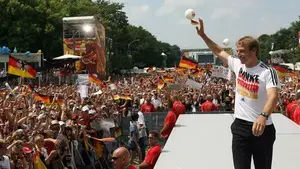
He has also developed a reputation - at least in Germany - for the type of attractive, attacking football that has been sorely missing from Three Lions matches at recent major tournaments. Schmeckel continues: “A lot of people love him because of the ‘summer fairytale’ in 2006, when his team played an exciting World Cup and electrified the crowd.”
Klinsmann stayed in the Germany job for just one tournament before leaving the post to return to his family in California. He landed the Bayern Munich job two years later, and it was in Bavaria that his reputation took its first real dent.
The most damning indictment of his reign - which did not last a season - comes from former Bayern midfielder Toni Kroos, who was a teenager looking to break into the first team at the time. “During his time at Bayern I personally missed everything: An idea of how to play football, adequate communication - and success,” Kroos told Die Zeit in 2015.
“Although he tried hard, he was not able to handle all the stars today in Germany,” Schmeckel says. “Bayern fans will probably hate him forever, because he was the coach who suffered two of the most painful defeats in their recent history - 0-4 against Barcelona and 1-5 against Wolfsburg.”
Bayern have returned to the European elite since and Klinsmann might feel he can take some credit for laying the groundwork of that revival. Karl-Heinz Rummenigge, the Bayern chairman, puts the 51-year-old’s short-term failure down to a single error - his choice of assistant manager. Instead of appointing someone with experience of German football like Low, he turned to Martin Vasquez, one of his contacts in the United States.
“His second coach, the Mexican - who was a nice guy and a very good coach - didn’t know anything about the Bundesliga or about German football and I believe at the end that was a mistake done by us and done by [Klinsmann],” Rummenigge told Goal.
“Maybe we had to choose a German who knew the Bundesliga who could have helped him, like maybe how Joachim Low helped him during the 2006 World Cup. It was little, but in the end it was a very important mistake. I have to excuse him, because I know he suffered about that and in the end got fired here. But it was not his mistake alone. We also made a mistake.”
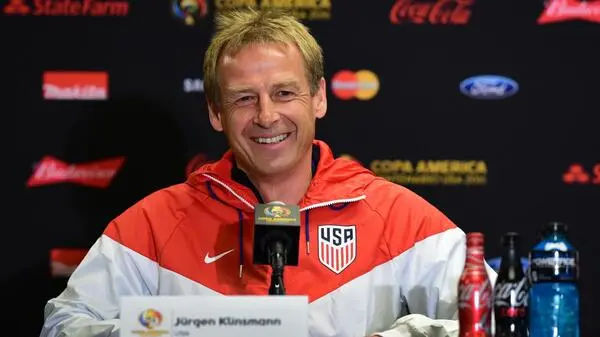
Klinsmann’s standing has been improved by the USA’s recent run to the semi-finals at the Copa America, which would seem on the surface to be evidence of how he is once again guiding a potential footballing superpower - though one with much less of a history of success than Germany - in the right direction. Opinions on the ground, though, tend to be more skeptical.
“His reputation for his work as U.S. coach is much stronger outside the USA than inside,” says Goal USA's Ives Galarcep. “There is a vocal segment that clearly want him out, but there are also fans who think he is doing well and also fans who think he gets more flack than he deserves.” Klinsmann navigated a very difficult group at the World Cup in 2014 but the USA were knocked out in the round of 16, as they had been under previous coach Bob Bradley in 2010. Bradley had also guided them to the final of the Confederations Cup.
“Over the last two years, Klinsmann has seen the team endure some of its worst struggles in decades,” Thomas Floyd, also of Goal USA, adds. “The U.S. finished fourth at the 2015 Gold Cup, which was the worst finish for the Americans since 2000. He lost the Confederations Cup play-off to Mexico in October. A World Cup qualifying defeat to Guatemala in March was the first U.S. loss to that opponent since 1988.
“The Copa America, meanwhile, divides opinion. In a vacuum, a run to the semi-finals is considered a success. But, to play devil's advocate, Klinsmann didn't have any overly impressive results in that tournament - the U.S. simply won against teams (Costa Rica, Paraguay and Ecuador) you'd expect them to beat on home soil before being thoroughly dismantled by Argentina.”
One thing both Germans and Americans alike can agree on is that Klinsmann’s relationship with the English media would likely be a turbulent one. “His public rhetoric is polarising,” says Floyd. “He makes a lot of sweeping generalisations about changing the culture of American soccer but the evidence that he's actually executing that vision is questionable.”
“He polarises, because he puts a strong meaning on nearly every theme and has no fear of criticising everyone he thinks deserves it,” Schmeckel concurs. “This is why he has a lot of enemies. Some say he is a hot-air artist and isn't an expert in tactical questions.
“If something he tries to realise does not work, he tends to not accept the media's criticism - quite the problem in England.”
...
- Goal