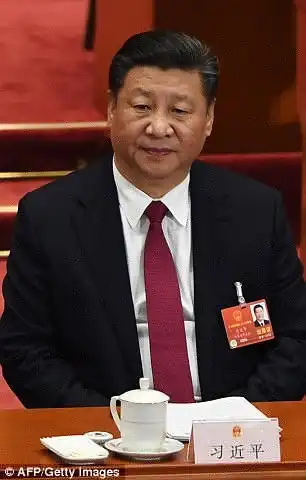
China's President Xi Jinping attends the second plenary session of the first session of the 13th National People's Congress (NPC) at the Great Hall of the People in Beijing March 9, 2018
When Xi Jinping was a boy, his father – a high-ranking government minister – fell out of favour with the founder of the People’s Republic, Chairman Mao.
As part of his family’s humiliation, the eight-year-old was paraded on a school stage in a metal dunce’s cap, while an audience raised their arms and shouted, ‘Down with Xi Jinping!’ Even Xi’s mother was forced to join in the chanting.
He was then sent to be ‘reformed’ in an impoverished, rural commune.
Yesterday, in an extraordinary reversal of fate, that schoolboy was affirmed as the most powerful man in China since Mao when the People’s Congress in Beijing rubber-stamped a constitutional amendment, abolishing the legal limit of two terms on China’s presidency.
In effect, it made Xi, its leader in perpetuity – or as some would have it, dictator.
With ruthlessness and cunning, he worked his way up through the ranks of the party that treated his family so appallingly, from local to national politics, and saw off rivals while establishing political and popular support with his war on corruption. And as a former peasant who toiled in the fields, his ‘man of the people’ credentials have done him no harm.
He has already declared that his own name and ideas are written into the nation’s constitution, as ‘Xi Jinping Thought’ – an honour he shares only with Mao. We in the complacent West would do well to wake up to the vaulting ambition of the leader of the world’s most populous state. The question now is whether power will go to his head.
We are used to expansionist threats and sabre rattling from nations such as Russia and North Korea, but we don’t expect it from China, which is traditionally insular and inward-looking. It is, after all, the country that built a Great Wall around its borders to keep out foreign influences.
But Xi is intent on reversing that centuries-old trend: China has established itself as global player in trade; it is massively expanding its military and now it wants global political influence to match. In some ways, this can benefit the West. For example, Xi has put pressure on North Korea’s dictator, Kim Jong-Un, to halt his missile tests and even roll back the nuclear programme. Donald Trump’s recent boasts of a diplomatic breakthrough, with arms talks to come, would have been unthinkable without Xi’s influence.
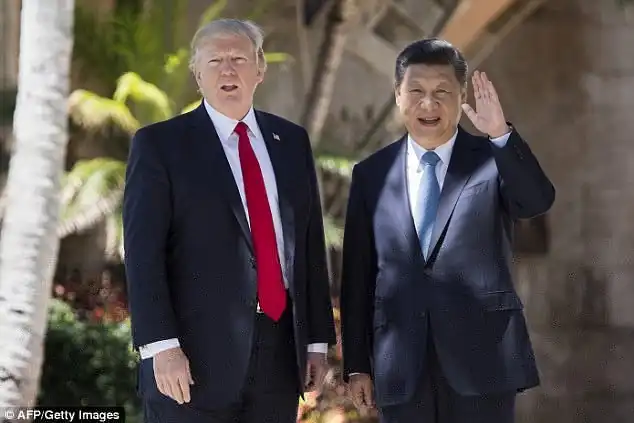
Chinese President Xi Jinping (right) waves to the press as he walks with US President Donald Trump at the Mar-a-Lago estate in West Palm Beach, Florida, April 7, 2017
If the world becomes a safer place in the short-term as a result of this new willingness on China’s part to play the part of a global power-broker, we should all be relieved. But as yesterday’s declaration reveals, Xi isn’t interested in the short-term. He lays longer plans. He has had several opportunities to get the measure of Trump: first at a meeting last April in Florida at the President’s Mar-a-Lago resort, later at the G20 talks in Hamburg, and then again when the two met in Beijing last November. They seemed to hit it off on strategic issues. But the relationship between them is a strange one, neither will feel comfortable in a partnership of equals.
Trump has already asserted his independence by announcing serious trade restrictions on Chinese steel and other imports. But China is not only a major trading partner of the United States but a colossal underwriter of American debt. The government in Washington could not function without borrowing hundreds of billions, financed by Chinese loans. If China withdraws that support, in retribution for Trump’s trade blockade, what happens to the United States economy?
And if Xi stops twisting Kim Jong-Un’s arm, what happens to Trump’s much vaunted peace talks? The Chinese President has manoeuvred himself, not just into one commanding position, but into a whole array of them.
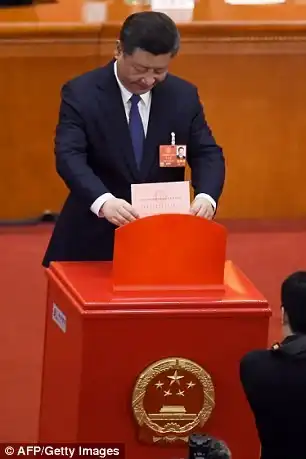
Chinese President Xi Jinping votes during the third plenary session of the first session of the 13th National People's Congress (NPC) at the Great Hall of the People in Beijing on March 11, 2018
It is not only America that is suddenly uncomfortably aware of Chinese strength. India, too, is eyeing its immense neighbour with unease after Xi sent China’s new navy – which he has committed huge investment to – into the Indian Ocean. This none-too-subtle display was prompted by a dispute over international policies concerning the Maldives, but Xi knows the world will take notice of a fleet of battleships. Meanwhile, across Eurasia, he has been the driving force for a new Silk Road linking China’s factories to Western Europe via Putin’s Russia, making Moscow the willing junior partner of Beijing.
All this confirms Xi as the most powerful and ambitious man in Chinese politics since the death of Chairman Mao more than 40 years ago – with one signficant difference. Mao wanted to break completely with China’s cultural past – the hallmark of the bourgeoise –Xi has a different strategy and wants to celebrate it.
He is determined to restore the country’s links to its heritage and arts and foster a new creed of nationalism in place of Communism. Chinese artworks and treasures, which were scattered to the winds during the Cultural Revolution of the Sixties, are being bought back from the West by Chineses multi-millionaires who see themselves as nationalist champions. Xi’s own wife, Peng Liyuan, a singer who entertained the troops after the Tiamen Square massacre in 1989, is at the forefront of this movement.
From the arts to geopolitics, trade wars to nuclear peace talks, Xi seems to have thought of everything. His carefully constructed powerbase may have one weak point: if he is President for life, then the ambitions of the country’s rising stars below him could be thwarted – risking political stagnation and infighting.
But for now, the West cannot risk complacency, not now that China is controlled by the Thoughts of President Xi. If Mao gave China independence, and former president Deng Xiaoping rebuilt the economy, then Xi is dedicated to making it a force to be reckoned with once more.