EXCLUSIVE:
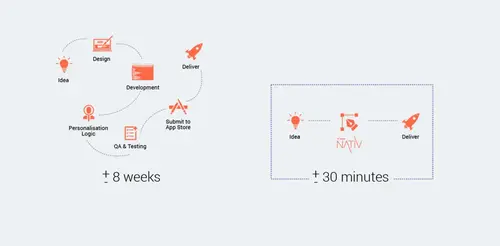
MoEngage, the mobile marketing automation platform, has announced the launch of in-app NATIV, a new product feature that allows marketers and product managers to create personalized in-app experiences for app users in just a few minutes without having to depend on engineering and design resources.
We’ve been spending tons of time evaluating the relationship marketing and engineering have with one another on mobile products. Sometimes, it’s tumultuous. Marketing wants to be enabled to do everything and anything. Engineering wants it to work, and to happen on time. Marketing doesn’t care. Make it do everything!
MoEngage’s new offering may alleviate some of that pain.
 According to Adobe’s annual mobile maturity study, more than 89 percent of IT respondents claimed that mobile is IT’s responsibility — whereas nearly 50 percent of marketers said mobile belongs to them. With mobile growth increasingly becoming a top priority for businesses in nearly every vertical –that means it’s also creating demand for faster, continuous development cycles that challenge traditional IT infrastructure and development methodologies.
The mobile app landscape is also getting so much more competitive as of late. Consider the following: Around 90 percent of a mobile user’s time spent on a device is in email, a preferred social network, and a messaging client. That’s potentially scary news for app developers and great news for mobile “enablers” — the engagement tools that help you grow your apps. However, the forgotten stat in that equation is that time spent overall on mobile continues to climb. This is a hugely important fact — and it means mobile really is maturing, and the window of opportunity for connecting with users at the critical moment of impact is shrinking.
It’s no longer about “which A/B test should I run” or “which segment should I optimize” — it’s how several tests can you run concurrently, and which tools will get me there without killing my app experience? NATIV helps marketers try this without tapping critical engineering resources. Marketers can choose from a large collection of customizable templates for size, color, shape, transparency, and position to deploy campaigns that appear natural to the app. The platform addition helps create and execute campaigns in the moment, with just a few clicks.
For example, a travel company can show relevant ‘activity offers’ to users travelling to a particular city soon after they complete their ticket booking. Or a taxi app can have an animated in-app message that is displayed in the shape of a car (cute), which brings authenticity and seamless connection to the experience. Being able to test and learn like this quickly is absolutely critical to driving success in an app, where the moments to compete for a user’s attention are quickly shrinking.
We’re studying mobile marketing at VB Insight
Add your voice, and we’ll share the data with you
The mobile marketing landscape is quickly evolving
We’ve been actively tracking the mobile enablement space over the last 20 months or so. We see mobile marketing analytics focused (audience measurement) vendors, mobile marketing automation focused (engagement), some hybrids of both, and then a whole demand side of ad management tools to drive paid acquisition and engagement. How does it come together under one roof for marketers?
“We see customers demanding more integrated functionality within one of the three categories however, don’t see tons of integration yet. The first big wave of consolidation will be between measurement and engagement. It’s a natural relationship and is already happening,” Raviteja Dodda, CEO and Co-Founder of MoEngage told me.
“The request from customers for more functionality is more across channels than anything else. Integrating web, mobile-web and mobile app is a request driven by marketing teams who are looking at the entire user lifecycle from customer acquisition through uninstall. Marketing teams aren’t technical and for several reasons don’t want to create data silos to have to measure across.”
“Companies are engaging users, not channels so they have to be where the user is and several times it’s following the user between platforms. We see attribution companies staying focused on attribution and not venturing beyond the install. Third, we see marketers demanding more integration with legacy systems. Retailers for example are integrating shopper databases to personalize push notifications.”
With so several tools in an actively expanding (and contracting) landscape, we’re seeing a new need for testing and integration players emerge. “I know from speaking with mobile marketers that while powerful, tools can be a thorn in their side when it comes to QA and integration for engineering. I believe this will continue to propel mParticle and Segment forward and introduce new players as well. However, these tools (Segment, mParticle) currently primarily focus on data sharing and have limitations, so app companies need to still integrate partner SDKs for some use-cases.”
I asked Dodda to give me three tips for mobile marketers to be thinking about in 2016. “When it comes to user engagement here are 3 tips we see having nearly universal uplift in user engagement: 1.) Personalization – do it. Make messaging with users relevant based on their interaction history, location, time and feedback they’ve provided. 2.) Real-time behavioral triggers. Trigger user communication based on things they do or don’t do. Don’t treat push notification like email. Broadcasting isn’t rewarded. Users are asking themselves “why couldn’t they send this to me at a more relevant time” It’s all about relevancy. 3.) Ask for feedback. You’ve got an open channel of communication and at the right time can prompt users to give you feedback for a variety of reasons. Use it to iterate and improve.”