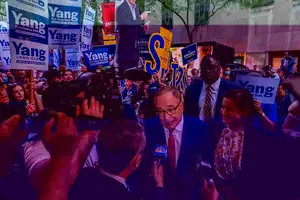
After a season of endless zoom forums, erratic polls and a truncated campaign season, the race remains a tossup less than a week out. With ranked-choice voting throwing more uncertainty into the process, the Democratic nominee, who is all but certain to win the general election, will likely not be named until well after Tuesday’s primary.
That uncertainty looked apparent among the candidates who took the stage at NBC’s fabled studio 8-H — the longtime home of "Saturday Night Live."
Brooklyn Borough President Eric Adams, a previous NYPD cop who has led recent polls, and Andrew Yang, the one-time frontrunner in the race who has recently fallen behind, are both aiming to portray themselves as the best candidate to ensure public safety — a dominant theme in the race as shootings and hate crimes surge.
Yang tried to undermine Adams’ tough-on-crime credentials — deriding his past advice for New Yorkers to confront their neighbors over illegal fireworks and bring guns to church for protection, and touting his own recent endorsement by the NYPD captains union, where Adams was once a member.
“They think I’m a better choice than Eric to keep us and our families safe,” Yang said, adding that one police captain was taken aback after a woman who did confront neighbors over fireworks, as Adams encouraged, was killed. “This was the most irresponsible thing he’d seen from a public official, and it’s not the kind of leadership he wants to see from the next mayor.”
Adams retorted that the union disliked him because he advocated for reform while on the force, and that he never sought their endorsement.
The final days of the campaign will reflect a tight race between Yang, attorney Maya Wiley and previous Sanitation Commissioner Kathryn Garcia, all of whom are trying to catch up to Adams. Wiley is running to the left, surging after other progressive candidates’ campaigns stumbled, while the other leading candidates are more moderate.
Yang piled on when candidates were asked to name the worst idea they’ve heard a candidate propose, singling out the previous cop’s declaration after a synagogue shooting that off-duty law enforcement officers should carry guns to their houses of worship. Adams in turn cited Yang’s proposal for basic income payments to some New Yorkers, labeling it “Monopoly money.”
Wiley is proposing to cut the NYPD budget, in contrast to Adams and Yang, who both support bringing back a version of a controversial anti-crime unit disbanded because of civilian complaints.
“The worst idea I’ve ever heard is bringing back stop and frisk and the anti-crime unit from Eric Adams, which, one, is racist, two, is unconstitutional and, three, didn’t stop any crime,” she said.
Tens of thousands of New Yorkers have already cast their votes: As of Wednesday, 84,132 ballots have come in through early voting, which kicked off on Saturday, according to the city Board of Elections.
But the turnout so far has been slow compared to the hordes who lined up to vote early in the November presidential election. Going into the closing weekend of the race, campaigns have much more work to do to win over and turn out potential supporters.
Garcia, running on her skills as a manager, identified hashtags like #DefundthePolice as the worst idea she’s heard from an opponent.
And the question prompted one of the most intense exchanges of the night between Dianne Morales, a previous nonprofit executive who supports defunding the police, and Ray McGuire, a Wall Street vet who opposes it.
McGuire said the defund movement was not right for Black and brown communities, prompting Morales, who is Afro-Latina, to cut in: “How dare you assume to speak for Black and brown communities? You can't do that.”
“I just did do it,” McGuire, who is Black, shot back. “I’m going to do it again. Black and brown communities do not want either defund or stop and frisk, full stop.”
Both candidates have lagged in polls, with Morales’ campaign imploding after staff attempted to unionize, costing her what had been growing support on the left.
The city’s move to ranked-choice voting, a system that allows voters to choose up to five candidates in order of preference, makes the results all the more unpredictable. Even if the polls hold and Adams comes out on top, there’s no guarantee he'll ultimately win the nomination once all the down-ballot votes are tallied.
A Marist poll released this week showed Adams ultimately beating Garcia after 12 rounds of ranked-choice voting. But a different survey by the conservative Manhattan Institute has Adams winning the most first-place votes, but narrowly losing to Garcia in the end.
While Yang hinted earlier in the day at a potential ranked-choice alliance with another candidate, none materialized during the debate.
And New Yorkers could be waiting quite some time for results: First choice votes will be reported on election night, but ranked choice tabulations will not begin until at least a week afterwards.
Yang zeroed in on concerns about mentally ill individuals living on the street, an issue that has been present in the city for years but became more noticeable as the Covid-19 pandemic emptied the streets of office workers and tourists.
“Mentally ill homeless men are changing the character of our neighborhoods,” Yang said, adding that a friend of his wife’s was recently punched in the face. “Families are leaving as a result.”
He advocated increasing the number of psychiatric care beds and forcing people off the street if they’re deemed a danger. “We've the right to walk the streets and not fear for our safety because a mentally ill person is going to lash out at us,” he said.
City Comptroller Scott Stringer, who instead emphasized the need for affordable housing, called that “the greatest non-answer of any debate.” “Not one specific idea, not one specific plan,” he said. “How much is this going to cost, if I can ask you?”
Stringer was an early progressive favorite in the race but has faded after two allegations of s3xual misconduct.
The candidates were also pressed on how they would tackle a projected $5 billion deficit once the city runs through its federal aid package, though few detailed specific cuts.
McGuire said his rivals were “talking loud, saying nothing. ... You’ve got career politicians here who clearly don’t understand the basics of 101 economics and how you manage a budget,” he said. “You asked a question, what you are going to do with a $5 billion budget [deficit]? Nobody answered that. They’re talking about what else they’re going to pile on to the budget.”
The candidates agreed on a few things, all saying they would not offer a job in their administration to the current mayor, Bill de Blasio. And all said they get six or fewer hours of sleep, below the recommended eight hours.