
Fashion retailer Next has withdrawn a baby sleeping bag from sale following a new mother's alert regarding potential safety hazards.
The product in question was a pink floral 2.5-tog sleep bag featuring removable sleeves, priced at £28, and marketed for infants aged zero to six months. However, after purchasing the item for her own newborn, Emma Hunter identified a serious design flaw.
The 29-year-old from Norwich observed that the neck opening of the sleeping bag was excessively wide. This raised concerns that her daughter, Rosie, now three-and-a-half months old, could slip down inside the bag, become trapped, and potentially suffocate.
Both Emma and her husband agreed that placing Rosie in the sleeping bag was entirely unsafe. Following Emma's proactive action in highlighting the issue, Next has removed all references to the product from its official website.
In a statement issued to the BBC, a spokesperson for Next confirmed: "We can confirm the item has been removed from our website and all stores."
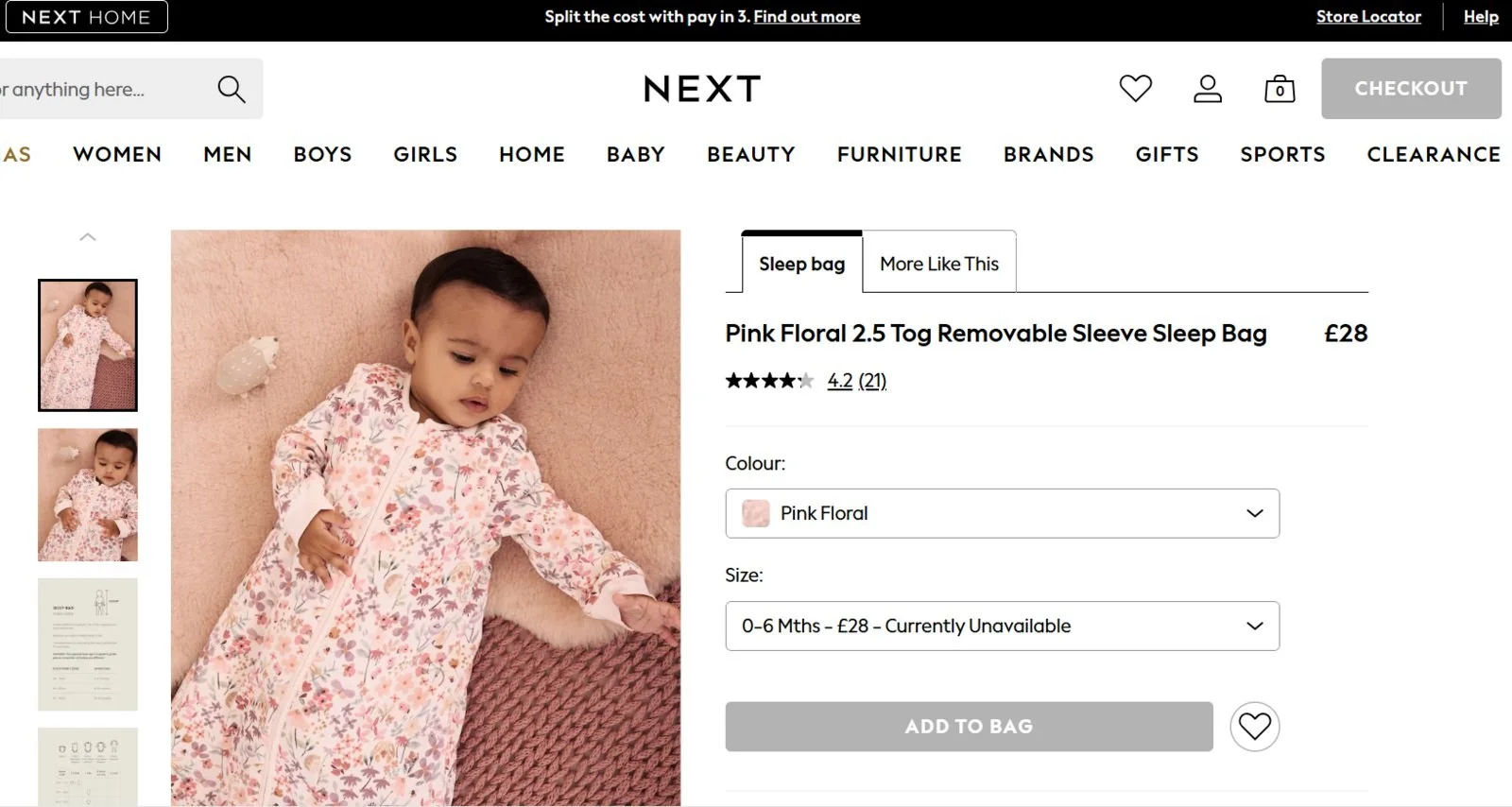
The spokesperson added: "A product recall is in place, and we are contacting all customers who purchased the item directly to advise them of the appropriate next steps."
Nevertheless, Emma claims that during her initial communication with Next, their response was "quite laissez-faire," with the company merely offering her a refund. She challenged this, stating, "But I said, 'It's dangerous; surely you shouldn't be selling it anymore, and there should be a product recall?'"
This incident spurred Emma to conduct further research into product safety standards. Her investigation revealed that the Next sleeping bag did not comply with British regulations, despite bearing a label explicitly stating otherwise. According to Emma's measurements, the neck hole of the Next sleeping bag was 36cm, while the maximum permissible neck circumference for a sleeping bag of that size, suitable for Rosie's height of 59cm, should be 32cm.
The British Retail Consortium (BRC) elaborates on its website that "one of the significant hazards arises if a child slips through the neck opening of the sleep bag such that the material of the sleep bag covers the child’s head." They warn that "Suffocation can occur if the material covers the child’s nose and mouth and may lead to the brain becoming starved of oxygen, which may result in asphyxia and potential brain damage or fatality."
Key Safety Guidelines for Baby Sleeping Bags
The Office for Product Safety and Standards offers crucial advice on ensuring a baby sleeping bag is safe:
- It should feature armholes.
- It must not have any drawstrings.
- Hoods or face coverings are not permitted.
- There should be no loose parts or fasteners.
- Cords are strictly prohibited.
Additionally, sleeping bags for infants under one year old should not be weighted. To properly check the fit, parents should ensure the neck opening is sufficiently snug to prevent the baby's head from slipping down. It is recommended to allow space for one or two fingers between the neckband and the baby's neck. The baby's legs must have ample room for free movement, and the material should never ride up to cover their chin, mouth, or nose.
To avoid overheating, which is linked to Sudden Infant Death Syndrome (SIDS), refrain from using two sleeping bags simultaneously or placing a blanket over the top. Regularly monitor your baby's temperature by feeling their neck or chest (not their hands or feet) to ensure they are neither too warm nor too cold. More comprehensive information can be found on The Lullaby Trust website.
The EN 16781 standard specifically outlines the maximum and minimum neck opening circumferences, which are calculated in relation to a child’s height, alongside three potential development sizes for sleeping bags. For instance, the regulatory body mandates that an infant between 50cm and 65cm in height requires a sleeping bag with a minimum neck circumference of 28cm and a maximum of 32cm.
Another critical danger is hyperthermia, or overheating, which may contribute to SIDS, particularly in sleeping bags equipped with hoods. A baby's head plays a vital role in heat regulation, hence sleeping bags are prohibited from featuring head, face, or chin coverings and must undergo rigorous testing to verify their thermal resistance.
Emma, whose brother tragically died from SIDS—the unexpected death of an apparently healthy baby under 12 months, typically during sleep—asserted that it "shouldn't take an infant mortality to see change." She criticised Next for its perceived lack of "sense of urgency" in addressing the matter. "I expected a big high street store like that to have a certain standard. You put your trust into these retailers," she stated. "How can a product have a label on it saying it met the British standard when it clearly didn't?"
Next's sleep bag, which was available in three sizes, is now under investigation by manufacturers and is listed as "currently unavailable" online. A spokesperson for Next informed the Daily Mail that "to date, no injuries" have been reported in connection with the item.