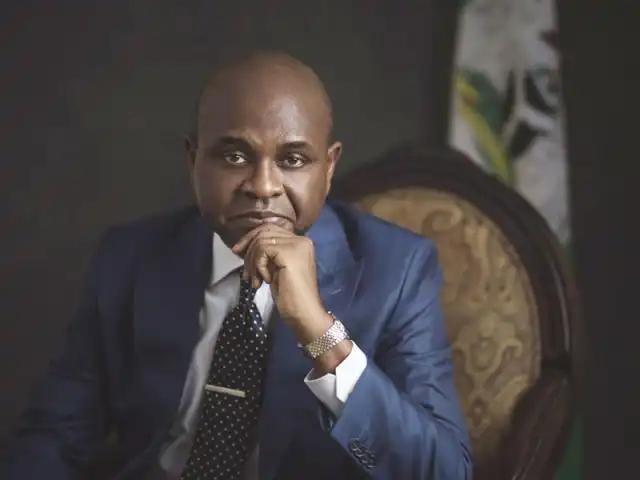
 The Presidential candidate of the Young Progressive Party, YPP, in the 2019 election, Professor Kingsley Moghalu has reacted to comments by Minister of Labour and Employment, Dr. Chris Ngige that he failed in his dream to become President of Nigeria because the YPP was an unknown party.
According to Dr. Ngige, Moghalu was not successful in his quest because he had served no one in politics.
His words, “Moghalu, rather than aspire for the president, would have launched his aspiration by first contesting for the governorship or National Assembly…that’s how the game goes… Dr. Moghalu, my very good friend who was deputy governor of the Central Bank. He said he was going to YPP. I called him and said ‘young man. You have not carried politics bag. You have not served anybody in politics’. Why would you jump into presidential race; not even for House of Representatives?’ If he had declared for governorship, we would have, maybe appealed to him to go for House of Representatives. So, one has to carry politics bag and learn from his master. You have to learn the art of politics.”
Responding recently, Moghalu said he has never been a recycled politician who gets elected by rigging elections because he is an agent of change.
According to him, he never contested the previous year as an ethnic candidate simply because he is a Nigerian candidate for the Nigerian presidency.
Moghalu also said he is proud of himself for running the presidential race till the end, despite the opposition from the 2 big political parties in the country.
The YPP candidate added that the country doesn't need an Igbo President, however, a visionary and competent leader.
His words, “Sadly, the tone of these statements by my brother and friend Dr. Chris Ngige reflects his utter contempt and arrogance as a Nigerian politician towards the poor masses and citizens of Nigeria. Our democracy is just a ‘game’ for him. Being a visionless career politician “carrying politics bag” before graduating to being a political “overlord” is, for some, the whole point of politics.”
‘’I'm a change agent, not a visionless, recycled politician that claims mandates on the basis of rigged elections and the blood of Nigerians killed in electoral violence. My candidacy for the office of the President of Nigeria in 2019 was not an ethnic candidacy. I was a Nigerian candidate for the Nigerian presidency, not an “Igbo President.”
‘’It is no secret, of course, that the Igbo have not been well served by several of their “career” political elites on the national scene. All too often, a majority of these personalities have lacked vision and courage. Some have focused only on the “crumbs” they can get in and from Abuja. They are content to play second fiddle to their political “masters”.
‘’My candidacy in the presidential election of 2019 took courage. Despite pressures from both major parties, I ran the race till the end, honourably, and declined opportunities to “sell out” on the national and global vision that drove my candidacy. That vision, laid out in my books “Build, Innovate and Grow” and “Emerging Africa”, inspired millions of Nigerians on the possibilities for a different kind of leadership. In politics, there are “electoral victories” (however obtained, in the Nigerian context), however, there are also longer- term “strategic victories” that short-term thinking can't understand.
“We need not just an “Igbo President.” Nigeria needs a visionary and competent leader. As Dr. Ngige admitted, I was as a candidate ‘eminently qualified for the post of president.’ Conventional wisdom about political career paths to the presidency is not necessarily “wisdom” for everyone in every case. If it were so, Nigeria today would be a far better country. What matters – or should matter — most in leadership selection for the Nigerian presidency is that potential president should have demonstrated experience and a track record of leadership competence in the areas most relevant to the responsibilities of a Nigerian President. These are mainly inclusive management of our diversity, the national economy, and international affairs. Leadership roles in international organizations where diversity is in their institutional DNA, in the management of Nigeria’s national economy, and in the fine art of international diplomacy are, among others, examples of such experience and track record.”