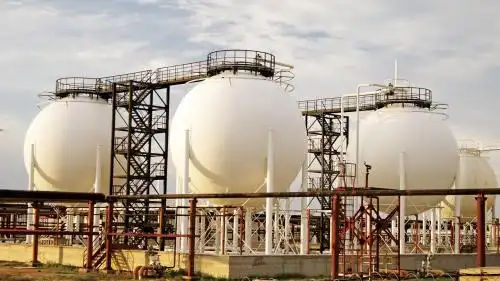
Gas plant
NEITI yet to validate NNPC’s report
Revenue from the sales of white product by the Pipelines and Products Marketing Company Limited (PPMC) from November 2015 to October 2016 stands at ₦1,128.64 trillion.
White product is obtained from crude oil processing. It includes natural gas, asphalts, automotive gasolines, aviation gasolines, fuel oils, kerosene, liquefied petroleum gas (LPG), lubricants, naphthas, and waxes.
The Nigerian National Petroleum Corporation (NNPC), which made this known in its monthly report, stated that Premium Motor Spirit (PMS) contributed about 88.28 per cent of the revenue collected with a value of ₦996.33 billion.
Meanwhile, Nigeria Extractive Industries Transparency Initiative (NEITI) is yet to validate the information provided by Nigerian National Petroleum Corporation (NNPC) in its monthly financial report.
NEITI, which made this disclosure in December Occasional Paper Series titled: BudgiT” released recently, stated the figures contained in NNPC monthly report will later be subjected to independent validation in subsequent industry audits.
It noted that although NEITI has not independently validated the data contained in the recent 14 issues of the corporation’s monthly financial report, these reports offer something close to real-time information about development in Nigeria’s oil and gas sector.
As stated by NNPC, a total value of ₦111.5 billion was collected as sales revenue for white products sold by PPMC in the month of October 2016 compared with ₦96.1 billion collected in the prior month of September 2016.
This is as a result of the increased in the purchasing power of petroleum products and the fluctuation in foreign exchange.
The increase in the sales of white product has also reduced NNPC’s trading deficit from ₦17.18 billion recorded in September to ₦16.85 billion in October.
Reduction in trading deficit would lead to government revenue, which could be used to finance the rehabilitation of the countries refineries.
Besides, a total of 49.52 million barrels of crude oil and condensate was produced in the month of September 2016, representing an average daily production of 1.65 million barrels.
This, NNPC stated represents, an increase of 5.99 per cent compared to August 2016 performance. “Of the September 2016 Production, Joint Ventures (JVs) and Production Sharing Contracts (PSC) contributed about 29.47 per cent and 55.99 per cent respectively. While AF, NPDC and Independent accounted for 8.30 per cent, 2.45 per cent and 3.79 per cent respectively”, it stated.
NNPC indicated a trading deficit of ₦16.85 billion as against September, 2016 trading deficit of ₦17.18 billion.
The marginal improvement, according to the corporation, was due to improved Petroleum Products Sales and enhanced cost control across the group. Factors that still drag NNPC performances include Force Majeure declared by SPDC as a result of vandalised 48-inch Forcados export line amongst others.
It noted that notwithstanding the reduction in vandalism, the number of vandalised points (101) is still very significant and impactful.
“NNPC is indeed in need of Nigerians support especially in areas of security and Infrastructural integrity. Favourable business environment will afford NPDC to reverse almost N20 billion monthly revenue currently being lost to vandalism to profit and create more jobs.
“In the downstream sector, in spite of liberalisation of Petroleum products and Government intervention to ease marketers access to foreign exchange, NNPC remains the major importer of petroleum products, especially PMS. Also, the ongoing Turn Around Maintece (TAM) is promising to entirely change the anemic outlook of the country’s refineries”, it added.
However, NEITI stated it is particularly interested in NNPC delivering on the commitments to further promote openness, transparency and accountability in the nation’s extractive industry.
As stated by NEITI, in 2016, there is suppose to be a development of an index by which NNPC could continuously measure its progress in improving its transparency and public accountability. “We observe that this index is yet to be developed. We encourage NNPC to intensify efforts in developing this index.
It noted that in the second quarter of 2016, like other National Oil Companies, the corporation is expected to produce the audited annual report and accounts as required by NNPC enabling Act.
The paper observed that as at November, the annual report is yet to be published, but urged NNPC to intensify efforts in producing this annual report.
It stated that the corporation was also expected to collaborate with International Oil Companies (IOCs) to carry out Value–For-Money Audit on all the Federation’s Joint Ventures with a view to business process improvement on projects execution of April 2016 to August 2016 issues.
“We do not know if this is already being done but again, we urge NNPC to focus resources to get this achieved. To continue with the review of existing PSCs to negotiate more favourable terms and improve revenue base to the Federation,” the report stated.
It added that NNPC reports reveal that the nation’s production of crude oil has been falling since January 2015 mainly as a result of increased militant activities and continuously falling oil prices.
NEITI stated: “Over 500,000bpd was lost as a result of activities of pipeline vandals and oil thieves in May 2016. The reports also show that on average, the nation’s refineries are operating below 10 per cent of their installed capacities. M
“This has led to a situation where most of the crude oil lifted by NNPC for domestic use is exported in order to import refined petroleum products. Also, the reports show that NNPC Group has been perpetually making losses. The bulk of crude oil export receipts are remitted to settle Joint Venture Cash Call obligations. These pieces of information highlight critical issues facing Nigeria’s oil and gas sector and provide timely information that will be useful in addressing these issues.
“While we commend NNPC for opening up and for consistently doing so, the monthly reports also reveal a few things that NNPC has committed to do but which have not yet been done. Interestingly, most of these border on issues of transparency and accountability, which are the core mandate of NEITI. Thus, NEITI is particularly interested in NNPC delivering on these commitments to further promote openness, transparency and accountability in the nation’s extractive industry”.
Guardian