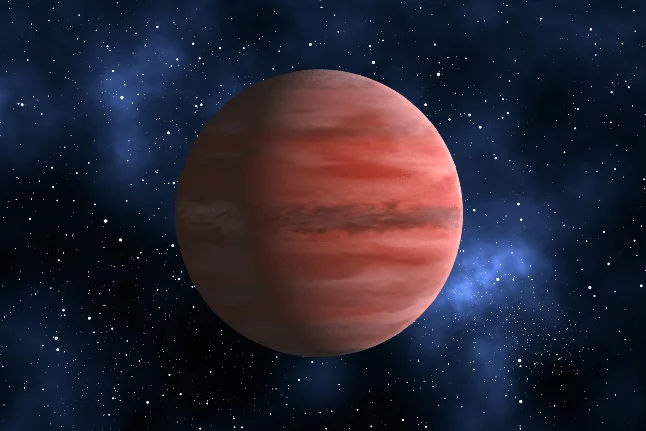
A remarkable celestial phenomenon has captivated astronomers: the identification of the first known 'disappearing planet.'
This intriguing exoplanet, designated TOI-2535 b, is a planetary body located beyond our solar system, approximately 5,878,606,000,000,000 miles from Earth. Scientists have maintained observation of this scorching gas giant since 2019, until March of this year, when it abruptly seemed to vanish.
Now, a team of astronomers from the University of California, Los Angeles, has successfully elucidated the reason behind TOI-2535 b's vanishing act. Samuel Yee, a co-author of the team's research paper published in Astrophysical Journal Letters, confirmed to Metro that the disappearance was not due to extraterrestrial involvement, nor has the planet become literally invisible.
Astronomers typically detect exoplanets as they pass, or "transit," in front of their host stars. During a transit, the planet appears as a minuscule speck that causes a momentary, slight dimming of the starlight.
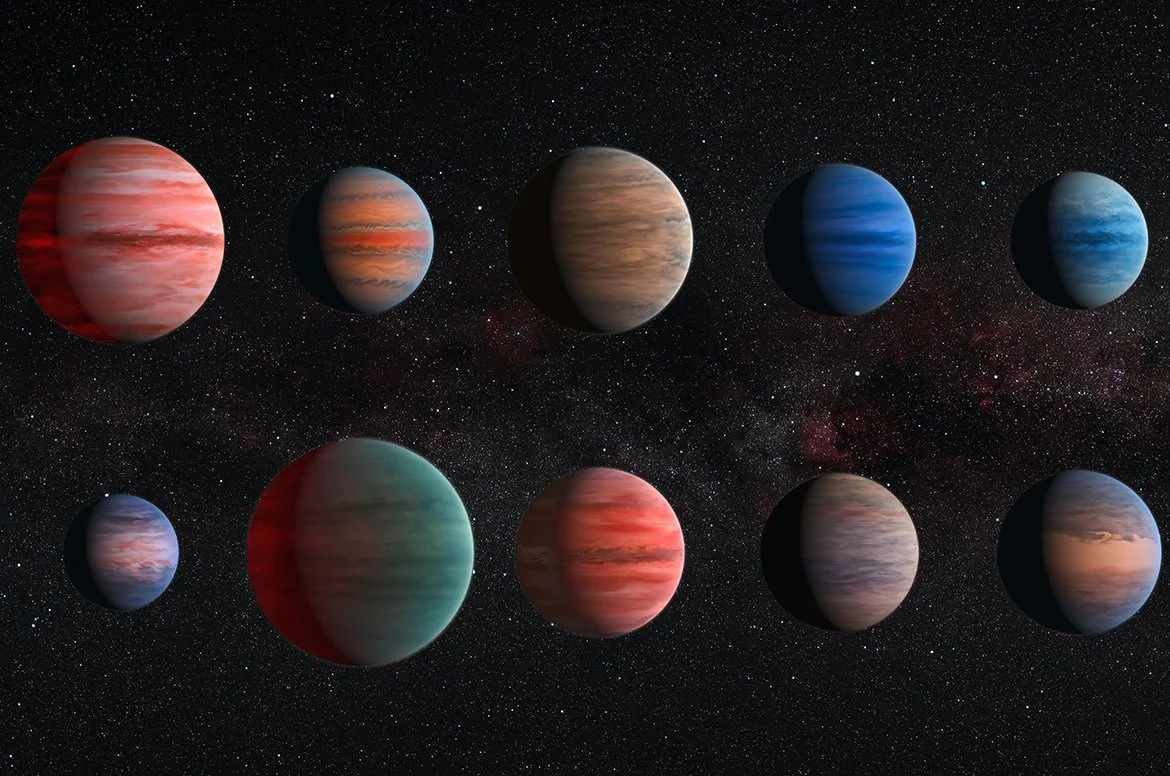
Characteristics of TOI-2535 b
TOI-2535 b is classified as a "hot Jupiter," a type of gas giant similar to Jupiter in our own solar system, but distinguished by its extremely close orbit to its host star. This exoplanet completes a full solar orbit in a mere 8.25 Earth days, which is ten times faster than Mercury, the closest planet to our Sun.
Transits also serve as a crucial method for stargazers to determine the atmospheric composition of exoplanets. As the celestial body crosses in front of its star, any atmosphere it possesses becomes illuminated. The gases within this atmosphere alter the colour of the starlight that ultimately reaches Earth-based telescopes, enabling scientists to deduce its chemical makeup. The filtered starlight from TOI-2535 b indicates that its atmosphere is composed primarily of hydrogen and helium, much like Jupiter, and it boasts scorching surface temperatures approaching 1,000°C.
Yee elaborated, "This is similar to a solar eclipse, when the Moon passes in front of the Sun, blocking its light." He added, "The only difference is that the planet only blocks a much smaller fraction of its star's light. In TOI-2535 b's case, about 1%."
Typically, planetary transits occur with predictable regularity. However, observations captured by Nasa's Transiting Exoplanet Survey Satellite (TESS) consistently showed TOI-2535 b's transits occurring either six hours too early or six hours too late. Over time, these transits became progressively shallower and shorter before the exoplanet appeared to dissipate into the vastness of space.
Yee's research indicates that these irregular transits suggest the planet did not actually disappear but was instead gravitationally perturbed by a neighbouring planet. This adjacent world possesses an orbit tilted relative to that of TOI-2535 b.
"The two planets’ orbits are tilting relative to each other, and their gravitational interactions cause their orbits to wobble, somewhat akin to a top," Yee explained. "The planet is still there, but we no longer see it transit its star."
This marks the first instance of a "disappearing planet," or more precisely, a formerly transiting exoplanet. According to the UCLA team's calculations, this gas giant will not be observable via transit for at least another three decades. Intriguingly, the team's findings also suggest that TOI-2535 b's neighbour might become visible via transit for the first time before then.
Yee concluded, "Just as there are planets whose transits are 'disappearing,' there are also planets whose transits are 'appearing,' caused by the same mechanism!"