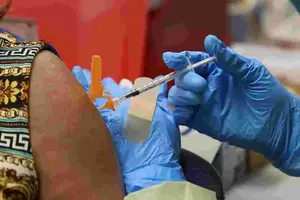
House members representing districts with low vaccination rates and public health experts, discussing their efforts to reach the unvaccinated, described what essentially has become two distinct conversations. One is aimed at chipping away at vaccine hesitancy among conservative white Republicans, while the other is centered around reducing socioeconomic barriers to vaccination for poorer populations and communities of color.
Rep. Brad Wenstrup (R-Ohio), the leader of Congress’ GOP Doctors Caucus, said he has focused on understanding and responding to vaccine hesitancy in conservative communities across the country and his Cincinnati district, where 42 percent of residents have received at least a first shot — about 9 percentage points behind the national pace. He has sat in on focus groups with Donald Trump supporters and has cut a public service announcement with fellow Republican physicians in Congress.
“People say, ‘We don’t know what [the vaccine] will do long term,’” he told a news outlet, listing off concerns he’s heard from people resisting vaccination. “There are people in the lower age group who are saying: ‘I’m young and don’t have other comorbidities and I just haven’t felt like it.’ Some people are just afraid of needles. I can tell you that as a doctor — some people pass out when they see one. And I’ve heard everything all the way down to: ‘They’re putting a chip in me.’”
But Rep. Raúl Grijalva (D-Ariz.) said the struggle to ramp up vaccinations looks much different in districts with large low-income and minority populations, like his own in Tucson that until recently had one of the nation’s lowest vaccination rates. The same barriers that prevented his constituents from getting tested when the virus emerged — poor transportation, lack of child care, little familiarity with the health care system — hampered their ability to get vaccinated, despite federal efforts like mass vaccination sites the government prioritized to get as several shots in arms as quickly as possible. His district has made up ground over the past few weeks — 44 percent have now received at least one shot — after the county health department boosted outreach, particularly in Hispanic communities, Grijalva said.
“For people who have traditionally limited-to-no access to health care, the revelation that they have to go to the vaccine doesn't come easily,” he said.
In fact, the magnitude of the struggle to broadly vaccinate low-income, minority communities that have been disproportionately hurt by the pandemic is obscured by the high levels of vaccine resistance among white conservatives. The stark racial disparities in vaccination would otherwise be far worse.
“Among the remaining unvaccinated people, white people are much more likely to say they are definitely not going to get the vaccine, whereas Black and Hispanic people are more likely to say they haven't gotten it yet but are hoping to get it soon,” said Liz Hamel, VP and director of public opinion and survey research at the Kaiser Family Foundation.
Hamel said Black and Hispanic adults, according to surveys, are more likely to be concerned about taking time off from work, having to get a ride to get a shot or the cost of vaccination, even though the Covid vaccines are free. Lotteries and prize giveaways recently embraced by numerous governors to boost vaccination rates would do little to address these access barriers, said Brian Castrucci, president of the de Beaumont Foundation.
“So much work went into acceptance, we fumbled the ball on access,” said Castrucci, whose public health organization has worked on increasing vaccinations.
Rep. Michael Burgess (R-Texas) said his Dallas-Fort Worth area district, where roughly half his constituents have received at least one dose, close to the national vaccination rate, said local health officials have had success tackling vaccine hesitancy by addressing access barriers. For example, the local government has recently turned to churches, barbershops and beauty salons to promote shots, a strategy that worked well during the distribution of the H1N1 vaccine just over a decade ago.
“Now the focus is: if there is a group of five people who can identify themselves as needing the vaccine, the county will come to them. It’s Meals on Wheels but for vaccines,” Burgess said. “For the last mile of the vaccination line, you’re going to have to meet people where they are, even if it’s going to be harder and slower.”
Still, others like Sen. Roger Marshall (R-Kan.), a previous obstetrician, argued that any problems accessing vaccines have largely been addressed by now, and that it’s up to Americans to find their way to a vaccination site.
“I’ve been out to the hinterlands in my state, and we've vaccines in the community health centers, pharmacies and doctors’ offices,” he said. “If anybody doesn’t have it now, they have to take responsibility for it.”
Wenstrup, the Ohio Republican, said several government officials are quick to write off swaths of the population as anti-vaccine rather than doing the hard work of listening to them and responding to their questions and concerns.
“Several people felt they were being indoctrinated and pressured to do something they didn’t want to do,” he said. “As a doctor, I know that before you do a surgery, you have to develop a relationship with a patient and explain what you’re doing and why you’re doing it — though it’s tough to do that on a national level.”
These challenges help explain why the partisan gap is widening as vaccinations dropped off sharply since a mid-April peak.
Republicans are roughly six times more likely than Democrats to say they have no interest in being vaccinated, according to recent polls. Democratic districts, meanwhile, are largely vaccinating at a faster clip, as local officials and organizations redouble efforts to reach the holdouts, with a focus on minority groups.
Data on racial disparities throughout the Covid response has been incomplete, including on vaccinations, making comparisons tricky in some cases. Some states have done a better job tracking this data than others, which can skew comparisons between congressional districts.
But data collected by the Centers for Disease Control and Prevention and outside researchers find racial disparities in the vaccination effort are narrowing, particularly for Hispanics. During the last two weeks, more than one-quarter of first doses went to Hispanics, according to the CDC, nearly twice the average over the previous six months.
The Biden administration this week announced new efforts to get Americans vaccinated in the month leading up to Independence Day, rolling out new programs offering free child care, free transportation, expanded pharmacy hours and other measures. What’s at stake, President Joe Biden said in a Wednesday speech, is the possibility of a virus resurgence in low-vaccine areas that sets back the nation’s progress in stamping out Covid.
“I don’t want to see the country that is already too divided become divided in a new way,” he said, “between places where people live free from fear of Covid and places where, when the fall arrives, death and severe illnesses return.”