Uranus' Aurora Mapped in 3D
Scientists have used the cutting-edge James Webb Space Telescope to create the first comprehensive 3D map of Uranus' captivating auroras, offering unprecedented insights into the ice giant's peculiar magnetosphere and upper atmosphere.
One of the world’s most powerful telescopes has peered inside Uranus to map its version of the northern lights in 3D for the first time. The pale turquoise ball of gas is one of the weirder planets in our solar system — and the bar is pretty high for that.
For one, Uranus orbits the Sun at a wonky 98°, so its magnetic poles face our star. Its magnetic field is also weirdly misaligned at a 60° angle. But for once, researchers have discovered something about Uranus which does make a lick of sense — what its upper atmosphere is made of.
Mapping Uranus' Magnetosphere
The European Space Agency observed Uranus rotating for 15 hours, nearly one Uranian day, to learn about the planet’s ‘strange’ magnetosphere. By looking through the James Webb Space Telescope, it found that Uranus’ ionosphere – the outskirts of its atmosphere – is, well, full of ions.

Ions are atoms that are electrically charged, such as by being baked by the Sun’s rays and the solar plasma it spits out. When this happens on Earth, it can cause the northern lights to form around the northern and southern poles.
The team’s findings, published in the Geophysical Research Letters, said Uranus’ auroras appear as bands on the East and Western sides.
Unravelling the Ice Giant's Energy Balance
Study lead author Paola Tiranti said: ‘By revealing Uranus’s vertical structure in such detail, Webb is helping us understand the energy balance of the ice giants. This is a crucial step towards characterising giant planets beyond our solar system.’
Ionised particles hover 5,000km above Uranus’ cloud tops, yet strangely, neither their temperature nor density peaks at the same altitude.
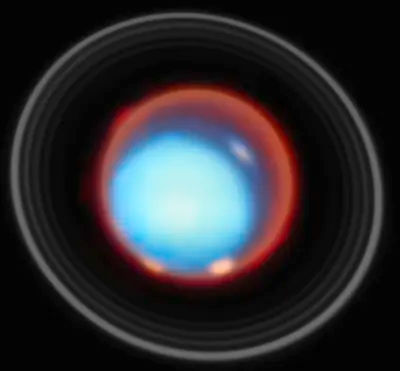
Instead, ions were warmest between 4,000 and 5,000km high and densest just 1,000km, a difference due to the planet’s magnetic field.
A Glimpse into a Wobbly Atmosphere
Unlike how most people think of an atmosphere, the ionosphere is wobbly and not fixed in place, making it hard to know where it is at any given time. So, having such detailed data about Uranus is a big deal, said Tiranti, a researcher at Northumbria University.
‘This is the first time we’ve been able to see Uranus’s upper atmosphere in three dimensions,’ she said. ‘With Webb’s sensitivity, we can trace how energy moves upward through the planet’s atmosphere and even see the influence of its lopsided magnetic field.’
Tiranti added that her team also reaffirmed earlier findings that Uranus, which swirls with mostly water, methane and ammonia, is cooling down. The average temperature of the seventh planet in our solar system was -153°C, far lower than expected.