China's Humanoid Robots Spark Military Fears
China's rapid advancements in humanoid robot technology, demonstrated by impressive displays at the recent Spring Festival Gala, are sparking global concerns about their potential military applications and the West's comparative lag in this crucial field.
Backflips, sparring, and breakdance: China’s humanoid robots are already proving to be formidable. The Asian country showcased the swift technological advances they are making in human-like bots at the annual Spring Festival Gala earlier this month. The kung fu-kicking skills on display have ignited fears that humanoids could become the future of global military conflicts, and that Western nations are falling behind.
Metro has spoken to leading war experts about the role humanoid robots could play in future battlefields, and whether they will remain a dystopian fantasy.
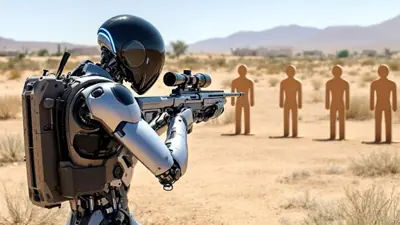
Humanoid Robots: The Future of Warfare?
Robots are already playing a vital role in modern warfare. In Ukraine, remote-controlled vehicles equipped with machine guns have conducted assaults on Russian forces. Drones currently dominate the skies and much of the battleground in large parts of the country.
‘This is because robots can do things that are too risky for humans to do,’ explains Dr James Pritchett. The War Studies Lecturer at Hull University told Metro: ‘In the West, we have become very casualty averse. We don’t like to take risks. Robots are a great alternative to that. You can send a machine to do a person’s job.’
What distinguishes humanoid robots from existing technology is straightforward: they possess two legs. This unique feature grants them ‘certain advantages’ over other types of robotic systems. Dr Pritchett explained: ‘There are advantages to having legs. You can go upstairs relatively easily. You can navigate certain kinds of rough terrain. Humanoids make sense in a complex urban environment.’

Consider the potential conflict over Taiwan, which China has long threatened to capture. The war expert speculates that humanoid robots would have a significant advantage fighting in the densely populated cities, such as Taipei, that characterise the East Asian island. Machines also excel at speed.
‘If you are charging across a fire-swept trench system, then a robot might be what you want,’ Dr Pritchett adds. He continued: ‘If you’re going to control a situation, take territory, keep it, and control it, you need to put a man on the scene with a gun. Now, a humanoid robot – if it’s smart enough and if the technology is there – could replace the man on the scene with a gun.’ That, he cautions, is a big ‘if.’
Challenges and Realities of Robot Warfare
Questions persist regarding whether human-like bots will be practical in a modern warzone or sufficiently advanced to perform complex tasks. ‘Robots aren’t good at creative adaptivity. AI doesn’t seem to be as good at that as we are,’ stated Dr Pritchett, who believes that humanoid military robots are at least several decades away. ‘If you put a robot, even a humanoid one, in a complicated counterinsurgency situation like Afghanistan, it might not be as effective as a human being.’
The Hull University lecturer also warns that cheaper ‘AI-controlled tanks’ and simpler robots might represent a more sensible military investment than ‘expensive’ humanoid ones. Peter Spayne, a former weapons engineer in the Royal Navy, agreed that visions of humanoid armies were ‘fictional at the moment.’
The expert on lethal autonomous weapons explained that China’s choreographed displays of their humanoid machines were conducted in ‘very confined and mapped environments.’ He told Metro: ‘Could I ask it to walk down the street with loads of unknown inputs coming in, such as other people, pedestrian traffic, cars, and animals? It’d probably trip over quite quickly or walk into a wall and get stuck.’
Although Mr Spayne believes that advanced ‘dystopian killer robots’ might be 20 to 30 years away, he doubted they would resemble humans. He said: ‘Tanks replaced horses, but tanks didn’t look like horses with four legs. So we will absolutely see armies of drones that look like quadcopters, that look like vehicles, that look like aircraft. But we won’t see something that stands six feet tall, on two legs, and walks like a human. To try and give it fingers and dexterity to operate a weapon system designed for a human is very, very weird.’ He concluded: ‘Good engineering says that’s not how you’d do it.’
While the weapons engineer doesn’t envisage humanoid robots on the frontline, that doesn’t mean they won’t play an important part in future global conflicts. Mr Spayne suggested: ‘I think they could be a tool in the box for search and rescue, disaster relief, and going into destroyed buildings. The places where something on wheels would probably come unstuck rather quickly, and it’s too dangerous for a person. But you’re not going to have a robotic firefighter making all human firefighters unemployed. They will be used in specialist situations.’
The Global Race for Humanoid Robotics
What these experts concur on is China’s leading position in humanoid technology. China accounted for approximately 90% of all humanoid robots sold last year and is home to over 451,000 companies involved in intelligent robotics. Two of the leading humanoid companies sold a combined 10,000 robots last year, whereas Elon Musk’s Tesla has reportedly built just 150 humanoids.
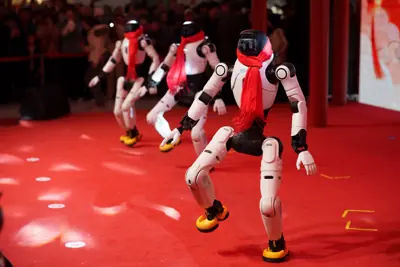
Dr Pritchett observed: ‘The West has approached AI a little differently. We are focusing on disembodied AI, like ChatGPT. It could be that we are missing out. If there is a military role for humanoid robots, then we’re probably behind the curve on it.’
UK Defence Innovation
The UK’s Ministry of Defence (MoD) has also been developing its own robotic systems. Early last year, they conducted a trial using robot dogs to defuse explosives. In May, they then carried out the largest-ever UK defence AI trial across land, sea, and air. A month later, the forces tested an underwater robot designed to prevent threats from sabotaging undersea cables and pipelines.
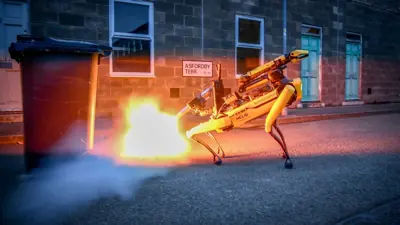
An MoD spokesperson stated: ‘This Government has reversed a four-year decline in Armed Forces recruitment, with more personnel now joining than leaving for the first time since 2020. We are driving transformation in our Armed Forces and making the UK the leading edge of innovation in NATO by equipping our forces with the full range of conventional and technological capabilities. AI is already embedded in our military systems, including drones, uncrewed surface vessels, and autonomous mine-hunting robots, and through UK Defence Innovation, we’re driving the development of data and AI-powered capabilities.’