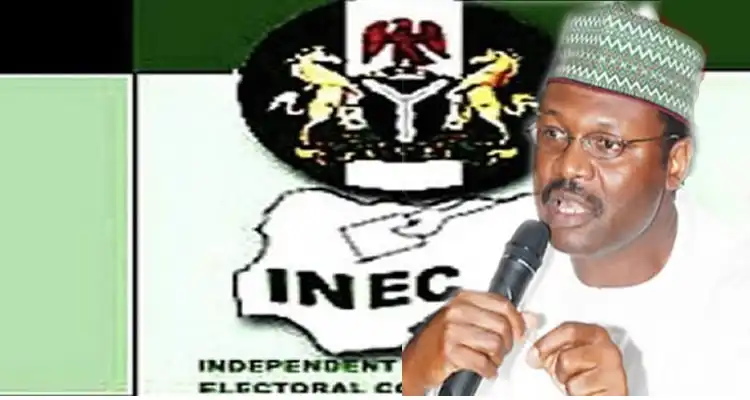
The Independent National Electoral Commission (INEC) on Thursday in Abuja stated it plans to conduct a voter card re-validation for selected registered voters across the country.
Mr Chidi Nwafor, INEC’s Director of Information and Communications Technology, disclosed this in his presentation on “Deployment of Technology in Nigerian Elections: The Progress Made So Far” at an E-voting workshop.
Nwafor, represented by an Assistant Director in the ICT Department, Mrs Abimbola Oladunjoye, stated that the plan was to address failure of card readers to authenticate some voters’ finger-prints during elections as recorded in some instances.
He stated that the revalidation would request the selected voters to do fingerprint re-capture.
“The use of the PVC and SCR gave a lot of credibility to the 2015 Electoral Process, as it greatly assisted in ensuring one-man-one-vote, though not without some challenges,” he stated.
Nwafor stated that one the main challenges experienced during the 2015 general election was the failure of card readers to authenticate fingerprints of voters with the PVC.
As stated by him, this is obvious with the rate of failure of authentication during accreditation with the use of card reader.
“The problem is that how do we address this before the 2019 general elections.
“So, INEC is thinking of doing a field exercise but the modality is still being deliberated.
“We don’t know if we are going to do full blown or call the people whom we have noticed from our data base to come for re-validation of their fingerprint re-capture.”
He added that INEC was also considering collaborating with the National Identity Management Commission (NIMC) to recapture/revalidate voters whose biometric data had problems.
The director stated that the commission would also upgrade its Software and Operating System (OS) of the card reader to address issues relating to the resetting of dates.
This, according to him, was to ensure that the card readers “firmware and software” are upgraded such that settings on dates and time cannot be tampered with manually.
“We notice that we have that when you remove the card reader battery it takes you back to default date, then you cannot accredit.
“So, we are looking at programming it in such a way that once it sees a network it will automatically go back to the date of voting,” he stated.
Nwafor stated that INEC had introduced some technology to improve on the electoral process, adding that the commission had not been able to actualize the desire to use electronic voting (e-voting) for the main balloting.
“In 2004, INEC embarked on studies and campaigns on the use of EVMs for the conduct of elections, but the restrictions of the Electoral Laws truncated the process.
“Section 52(1b) of the Electoral Act 2010 (As amended) states that the use of electronic voting machine for the time being is prohibited.
“However, the newly released Electoral (Amendment) Act 2015 has allowed INEC to determine the procedure for voting at elections and totally expunged the subsection prohibiting the use of e-voting.”
Nwafor stated that the commission was committed to consolidating the technology introduced to the country’s electoral process in spite of the challenges and brick walls the commission had encounter.
Some of these challenges, according to him, include funding, sabotage by political class and unwillingness to embrace change on the part of some Nigerians.
“INEC depends heavily on the use of IT to plant democracy on a very solid ground and build on what was achieved in the 2015 General Elections.
“The use of technology in the electoral process is crucial; considering that the level of political distrust in Nigeria is very high, the use of technology to enhance electoral credibility has become indispensible.
“The use of technology in the electoral process could be extended to other critical areas of electoral governance, as the law permits,” he also stated.
Also speaking at the workshop, Mr Sheidu Wahab, a Deputy Director in INEC, stated that the commission was in support of any process, including e-voting, that would make electoral process more credible.
Wahab stressed the need to carry out proper sensitization as well as pilot use of e-voting in isolated election, including those of students and labour union before that of state or national election.
The NAN reports that the workshop with “Making the Case for Urgent Introduction of Electronic Voting into the Nigerian Electoral Process” as topic, was organized by the Election Monitor, a Non-Governmental Organization.
.
.....