The 11th manager (either full- or part-time) of the Abramovich era will be able to choose his own back-four and promote young centre-backs without having to tip-toe round the “legend” who continues to be seen by many fans as the club’s spiritual guardian.
Sentiment was never going to dictate Roman Abramovich’s thinking as Chelsea take radical action to recover from the shock of brushing against the relegation zone.
Personal indebtedness was never going to outweigh the owner’s anger at having to sack Mourinho a second time. And you can bet Abramovich has been skulking around ever since then looking for people to blame, and for scores to settle. He might not have held Terry specifically responsible for Mourinho’s downfall but he probably felt ‘JT’ has been on the scene of too many dismissals for the next manager to feel completely confident of his power in the dressing room.
The Chelsea captain’s direct influence on Abramovich when Luiz Felipe Scolari and Andre Villas-Boas lost their jobs may have been overstated; but there is no disputing that Terry was at the tip of a group of senior players who always put things right when the P45 had been served.
Also on the cabinet were Frank Lampard, Petr Cech and Didier Drogba. The most assertive of that distinguished gang, Terry was the closest to being a kind of unofficial second manager who would not permit a great team to be brought low by a floundering manager.
The most recent to go was Mourinho (for the second time), who returned to the post in 2013 with no way of knowing whether Terry would play the docile old pro or potential adversary if things went wrong again.
Any senior A-list coach would be capable of deciding whether to pick Terry in the starting XI next season, when Guus Hiddink will have packed his emergency rescue kit away. But could the next man up the line also be sure Terry would not provide a focus for dressing room dissent? Would he accept being left out for the really big games or sport that familiar wounded look on the bench while the fans chanted his name?
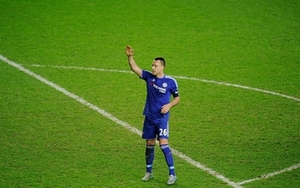
Rafael Benitez is the last Chelsea manager to take Terry on directly. Benitez thought he was on the wane and vulnerable to pace on the counter-attack. But any bookie laying odds on that tussle would have grabbed at any bets on Benitez emerging the winner.
When Mourinho withdrew Terry at half-time at Manchester City, each will have known a statement was being made. The unspoken truce that followed was never clear or clean enough for Mourinho to feel he could rely on Terry to lead the recovery, which never came. So the sight of Chelsea’s form improving was bound to irritate Abramovich on some level. If now, why not back then, when Mourinho needed it?
Back in those molten days after the Man City game, Gary Neville wrote a Telegraph Sport column arguing for “acceptance” by ageing legends that they might not play every game, and “clear communication” between player and club.

“If Chelsea sign John Stones,” Neville said, “I’d say John Terry becomes the most important player at Chelsea for the next three seasons - if Stones can just watch Terry 15 times a season in games and three times a week in training, just as players watched Paul Scholes at Manchester United. John Terry should be at Chelsea until he’s 36, 37 years of age.”
That football logic still applies, but it ignores the politics around a player so central to the Chelsea story that ‘JT’ has become a kind of shorthand for dressing room authority. If Carlo Ancelotti can be sacked in a corridor at Everton, and Dr Eva Carneiro treated the way she was, Terry can hardly be shocked at the Kremlin-esque coldness with which he was cut adrift.
For most of those 21 years Terry was a political winner. Then he became a political liability in the search for a new manager at a time when Chelsea cry out for transformation. Their stance may lack compassion but it complies with the brutal survival instincts of large organisations. Terry’s political clout ran out.
John Terry's career
- Telegraph