A young Iranian man, identified as 26-year-old Erfan Soltani, is scheduled for execution tomorrow, accused of "waging a war against God." His alleged crime stems from his participation in anti-government protests that have recently rocked Iran, leading to hundreds of civilian deaths. Critics vehemently condemn the impending execution, highlighting that Soltani was denied both legal representation and a fair trial, raising profound concerns about due process and human rights in the nation.
International Outcry Amidst Escalating Repression
The planned execution is reported to be the first directly linked to the current wave of protests, drawing sharp condemnation from human rights organizations worldwide. Iran Human Rights, a Norway-based organization, issued a stark statement, asserting: "The widespread killing of civilian protesters in recent days by the Islamic Republic is reminiscent of the regime's crimes in the 1980s, which have been recognised as crimes against humanity." The organization further emphasized the international community's duty to protect civilian protesters against mass killings by the Islamic Republic, urging global intervention. Soltani himself was initially arrested merely five days ago during a protest in Fardis, a town situated on the outskirts of Tehran.
Widespread Protests and Government's Draconian Measures

The internet in Iran has been largely cut off for several days in a deliberate attempt by the government to quell the massive demonstrations that ignited on December 28. Witnesses in Tehran, speaking to the AP news agency, described a heavy and intimidating security presence across the capital, with anti-riot police officers, clad in helmets and body armor, on standby with batons, shields, shotguns, and tear-gas launchers. The internet blackout has also crippled essential services, leading to smashed ATMs and banks struggling to complete transactions. The US-based Human Rights Activist News Agency (HRANA) reports a grim toll of 490 demonstrators and 48 security personnel killed so far, with over 10,600 arrests made within just two weeks of unrest, painting a picture of severe state suppression.
Tragic Toll: Lives Lost in the Fight for Freedom

The National Union for Democracy in Iran poignantly stated regarding Soltani, "His only crime was calling for freedom." This sentiment resonates with the stories of other victims, such as 23-year-old Rubina Aminian, a fashion student at Shariati College in Tehran, who was killed on January 8 after joining protest gatherings. Sources close to her family confirmed to Iran Human Rights that Rubina, a young Kurdish woman, was shot from close range in the head. Her mother’s heartbreaking testimony, "It wasn’t just my daughter; I saw hundreds of bodies with my own eyes," underscores the brutal reality faced by those participating in the demonstrations. Despite these widespread accounts, Iran's foreign minister, Abbas Araghchi, claimed on Monday that the "situation has come under total control," a statement for which no independent evidence has been provided. The internet shutdown and cut phone lines have made it increasingly difficult for external agencies like the Associated Press to independently verify casualty figures or the full scope of the demonstrations.
Image Captions
Erfan Soltain is scheduled to be executed tomorrow (Picture: X)
Soltani took to the streets with his fellow countrymen (Picture: X)
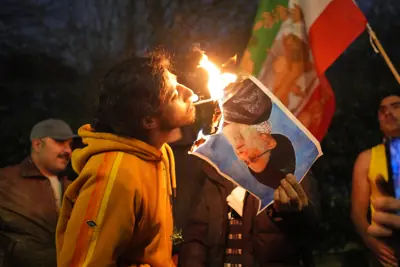
Demonstrators have been lighting cigarettes with the Ayatollah’s photo (Picture: PA)